Australian High Commissioner to Pakistan Timothy Kane has expressed optimism that negotiations on a modernised Pakistan-Australia Bilateral Investment Treaty (BIT) will be concluded by December, saying the agreement would help attract greater Australian investment to Pakistan.
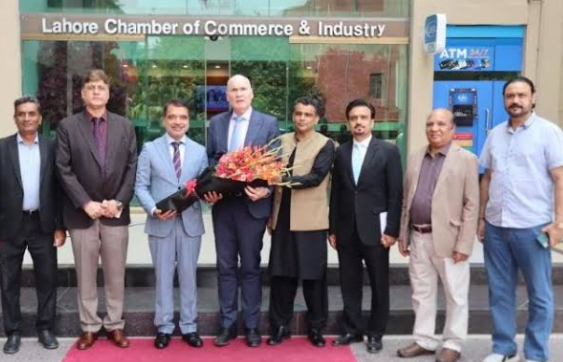
Speaking at the Lahore Chamber of Commerce & Industry (LCCI), Kane said Pakistan and Australia had maintained a Bilateral Investment Treaty since 1998, but the agreement needed to be updated to reflect the changing economic requirements of both countries.
He said finalising the modernised treaty would send a positive signal to Australian investors about the opportunities available in Pakistan.
LCCI President Faheem Ur Rehman Saigol welcomed the Australian envoy and stressed the need to strengthen bilateral trade and economic ties. He said Pakistan and Australia had maintained cordial relations since 1947 and could benefit from greater cooperation in agriculture, mining, education, technology and economic management.
According to State Bank of Pakistan data cited by the LCCI president, bilateral trade in goods fell from $973 million in 2024-25 to $672 million in 2025-26. Pakistan’s exports to Australia declined from $285m to $275m, while imports dropped from $688m to $397m during the same period.
Saigol called for joint efforts to reverse the decline and proposed increasing bilateral trade to at least $3 billion. He identified home textiles, apparel, rice, surgical instruments and sports goods among Pakistan’s major exports to Australia, while highlighting industrial workwear, safety gloves, auto parts, engineering goods, leather products, spices, food products, pink salt, marble, furniture and carpets as areas with further export potential.
He also urged the early convening of the Pakistan-Australia Joint Trade Committee, which has not met since March 2023, and called for discussions on a preferential trade arrangement to improve market access for Pakistani exporters.
The LCCI president said mining and minerals presented significant opportunities for joint ventures, with Pakistan possessing considerable mineral resources and Australia offering expertise in exploration, mining technology, mineral processing and mine management.
Kane said both countries needed to do more to expand their trade and economic relationship. Referring to the Joint Trade Committee meeting held in Canberra in August, he said discussions included improving market access for Pakistani mangoes and strengthening facilities for pre-export mango inspections in Pakistan.
Agriculture, he said, remained a key area of bilateral cooperation, with Australian agricultural trade with Pakistan reaching nearly A$1 billion last year. He said the Australian Centre for International Agricultural Research (ACIAR) had worked in Pakistan for more than four decades and invested almost $100m in agricultural research and innovation in partnership with local universities, businesses and other stakeholders.
Kane said Australia was supporting Pakistan in water management, improved seeds, drought-resistant varieties and climate-resilient agriculture. An Australian agricultural delegation was also visiting Lahore and was scheduled to travel to Faisalabad.
He highlighted growing cooperation in livestock and dairy development, noting that more than 100,000 Australian cattle had been exported to Pakistan, mainly to Punjab. According to Kane, Australian cattle genetics could help increase milk production and improve local herds.
He said a Pakistani delegation would visit Australia next month to explore opportunities in pulses, including varieties better suited to Pakistan’s climatic conditions. He also welcomed Pakistan’s recent efforts to improve its biosecurity system and said Australia was ready to support further improvements.
Kane said Australia was looking forward to exporting GMO canola to Pakistan following the country’s approval of genetically modified canola. He noted that Australia had traditionally supplied Pakistan with non-GMO canola.
Emphasising the need for balanced trade, the high commissioner said Australia wanted to see more Pakistani exports and investment in its market. He said Pakistani apparel manufacturers had strong potential in Australia, particularly given the country’s multicultural consumer base.
Mining, resources and education were also identified as areas with significant potential for bilateral cooperation. Kane said education remained an important component of Pakistan-Australia economic relations, although the number of Pakistani students in Australia had declined somewhat over the past 18 months to two years after reaching around 20,000.
He called for expanded cooperation in pharmaceuticals and biotechnology, saying Pakistan had considerable expertise and export potential in the pharmaceutical sector.
On business visas, Kane said Australia’s visa system was non-discriminatory and that genuine applicants who followed the required procedures and provided the necessary information generally had a strong chance of obtaining visas.
He noted that Pakistani professionals, including engineers, accountants and IT specialists, were making significant contributions to Australia’s economy. He said the Pakistani community in Australia numbered around 145,000 and had doubled over the past decade, while remittances from Australia to Pakistan exceeded $1 billion last year.
Kane said there were currently no plans for a free trade agreement between the two countries, but described the recent Joint Trade Committee engagement as positive and said Australia remained committed to strengthening bilateral economic relations.