
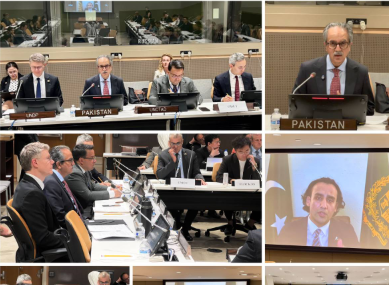
Minister of State and Pakistan Virtual Assets Regulatory Authority (PVARA) Chairman Bilal Bin Saqib has called on countries to develop coordinated global rules and institutional mechanisms to manage emerging digital financial technologies.
Speaking virtually at a United Nations briefing on Saturday, Mr Saqib said effective governance was essential to ensure that digital assets and other financial innovations contributed to economic inclusion, efficiency and wider access to financial services.
The briefing, titled “Digital Assets and Blockchain for Sustainable Development: Advancing Digital Finance through Innovation”, was held at the UN headquarters and organised by Pakistan’s Permanent Mission to the United Nations in collaboration with the UN Development Programme, UN Trade and Development and the Office of the Secretary-General’s Envoy on Technology.
The session brought together representatives of member states, UN agencies and private-sector stakeholders to discuss the potential of digital assets and blockchain technology in promoting sustainable development.
Mr Saqib said digital assets, tokenisation and distributed ledger technologies offered emerging economies an opportunity to modernise financial infrastructure and improve access to financial services.
He said the debate should focus not on whether these technologies would expand, but on how they would be governed and whose interests their development would serve.
Highlighting the global financial inclusion gap, the minister pointed to an estimated 1.4 billion adults who remain outside the formal financial system. He also noted that billions more face unequal access to financial services because of costly remittances, slow settlement systems and limited access to credit.
Mr Saqib said the potential of digital finance extended beyond payment systems. Digital identities and verifiable financial records could help small businesses, farmers and women entrepreneurs demonstrate their economic activity without relying solely on conventional collateral and documentation.
He added that tokenisation could facilitate new forms of capital mobilisation by allowing assets such as infrastructure bonds and renewable energy projects to be divided into smaller investment units.
Distributed ledger technology, he said, could also improve transparency and traceability in areas including public spending and supply chains.
However, the PVARA chairman cautioned that technology should not be viewed as an automatic solution to financial and economic challenges.
He highlighted potential risks, including market volatility, illicit financial activity, concentration of technological power and a growing regulatory divide between countries with advanced oversight mechanisms and those lacking such capacity.
Mr Saqib said governments faced a choice between actively shaping the future of digital finance or allowing technological developments to shape regulatory systems.
He stressed that regulation needed to evolve alongside innovation, warning that delayed regulation could expose consumers and markets to risks, while overly restrictive approaches could push technological activity into less transparent jurisdictions.
According to Mr Saqib, international experience increasingly suggests that regulation should help build markets rather than prevent their development.
He urged member states to use the UN briefing as a starting point for greater international cooperation on digital assets, financial inclusion, remittances, capital mobilisation, digital identity and responsible technology adoption.