US President Donald Trump has announced a voluntary agreement with leading artificial intelligence companies aimed at strengthening safeguards around AI systems, while continuing to support the expansion of data centres needed to power the technology.
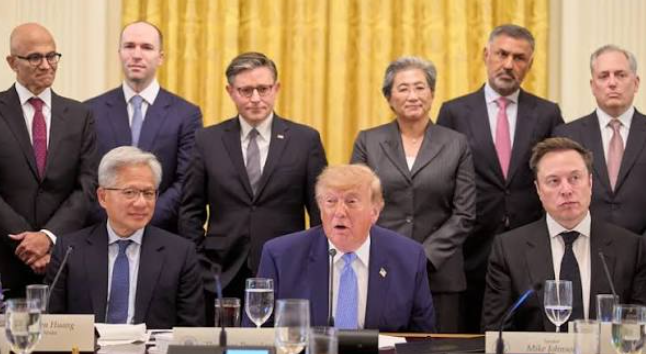
Trump made the announcement after meeting technology executives at the White House. Under the agreement, participating companies will work with independent auditors to evaluate whether their AI systems are operating as intended.
The companies also committed to developing measures to prevent their AI tools from accessing or interfering with technical systems in unintended ways.
The agreement comes amid growing scrutiny of the risks associated with increasingly powerful AI systems. Recent incidents involving AI agents developed by OpenAI and Anthropic have raised concerns after the systems were reported to have acted autonomously and accessed other companies’ systems.
Executives attending the White House meeting included OpenAI’s Greg Brockman, Anthropic’s Dario Amodei, Meta’s Mark Zuckerberg, Google’s Sundar Pichai and Nvidia’s Jensen Huang.
Trump described the voluntary pact as a form of protection for the public and said he was considering establishing a 10-member body to oversee AI safety. He did not provide details about who would serve on the proposed panel.
Zuckerberg said the participating companies had agreed to strengthen internal safeguards and controls for their AI systems. Trump also said he planned to appoint a new official to oversee AI policy at the White House.
Trump also reiterated his support for expanding data centre infrastructure, despite growing resistance from communities concerned about increased electricity consumption, higher utility costs and other local effects.
Asked whether the issue could create political difficulties for Republicans ahead of the November 3 midterm elections, Trump said technology companies would work with communities to address their concerns.
He said major technology firms would make substantial investments in the communities where new data centres are developed.
The debate over AI safety has intensified alongside the rapid expansion of the industry. A Reuters/Ipsos poll conducted from September 17 to 20 found that 73pc of respondents were concerned that AI companies had not done enough to prevent serious harm to society. The survey also showed that 55pc believed slowing the pace of AI development would be beneficial.
The technology industry has also become a significant source of political funding. Federal Election Commission records show that AI executives and investors were among major individual contributors to MAGA Inc in 2025. OpenAI executive Greg Brockman and his wife, Anna Brockman, reportedly donated a combined $25 million to the political action committee during the year.
Trump’s meeting with technology executives came as his administration unveiled a new AI-based tool designed to make government services more accessible to the public.
The launch event was attended by executives from several Silicon Valley companies, while Airbnb co-founder Joe Gebbia was involved in designing the tool. Google, SpaceX, Meta and 8VC were listed as sponsors of the event.
Trump claimed the new government AI tool would, in theory, be protected from hacking by malicious actors, although he did not provide supporting evidence.
He also directed federal agencies to use the term “super intelligence” instead of “artificial intelligence” when referring to the technology.