North Korea has claimed that artificial intelligence (AI) technology was incorporated into an intermediate-range strategic missile launched from the country’s Wonsan area, as tensions with South Korea remain high.
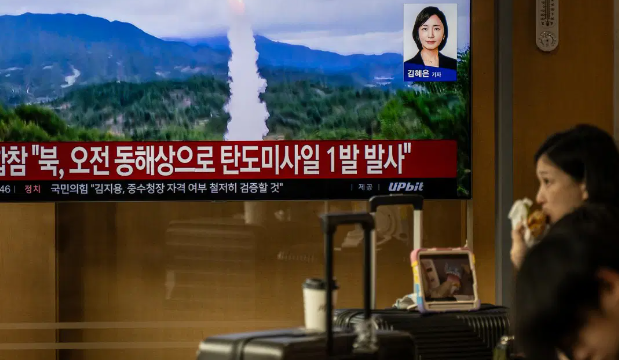
South Korea’s Joint Chiefs of Staff said on Saturday that it had detected a ballistic missile launched towards the East Sea, also known as the Sea of Japan. The missile travelled more than 700 kilometres, according to the South Korean military.
South Korea, the United States and Japan were maintaining close information-sharing and a coordinated defence posture following the launch, Seoul’s military said.
Hours later, Kim Yo Jong, the sister of North Korean leader Kim Jong Un, described the projectile as an “intermediate-range strategic missile”. She claimed the missile could alter its flight path at low altitude and said AI technology had been incorporated into the system.
Kim did not provide technical details about how AI was used but claimed the technology made the missile difficult to intercept. She also said North Korea had capabilities that she claimed would remain unavailable to other countries for several years.
Her comments followed Kim Jong Un’s remarks last month calling for greater use of AI technology in North Korea’s weapons systems.
Kim Yo Jong also claimed that South Korean forces had previously struggled to track North Korean missiles using a manoeuvring flight trajectory.
Analysts said AI is increasingly being integrated into military technologies worldwide, including missile and drone systems, but cautioned that North Korea’s claims about the capabilities of the tested missile could not immediately be verified.
Hong Sung-pyo, a senior researcher at the Korea Institute for Military Affairs, said AI could assist with target information and launch operations, while recent conflicts had demonstrated the potential military applications of combining AI with drones and missiles.
He said, however, that it was too early to determine whether North Korea’s claims regarding the missile’s capabilities were accurate.
Analysts have also suggested that North Korea’s missile programme may be benefiting from military cooperation with Russia, although the extent of such technological assistance remains subject to assessment.
The missile launch came days after South Korea’s military demanded an apology from Pyongyang over an explosion in the Demilitarised Zone (DMZ) that injured three South Korean soldiers.
Seoul and the US-led United Nations Command concluded that the blast was caused by North Korean mines placed on the South Korean side of the border. Pyongyang has denied responsibility.
North Korea has been strengthening its border infrastructure, including laying mines and constructing anti-tank barriers, as part of efforts to reinforce the frontier.
South Korean President Lee Jae Myung recently called for a return to dialogue with Pyongyang. Kim Yo Jong rejected the overture, criticising Seoul’s position and describing its demand for an apology over the blast as unacceptable.
She also warned that North Korea was prepared for any measures South Korea might take in response to the incident.
The latest missile launch has been viewed by analysts as another indication of heightened tensions between the two Koreas, following Seoul’s recent calls for diplomatic engagement.