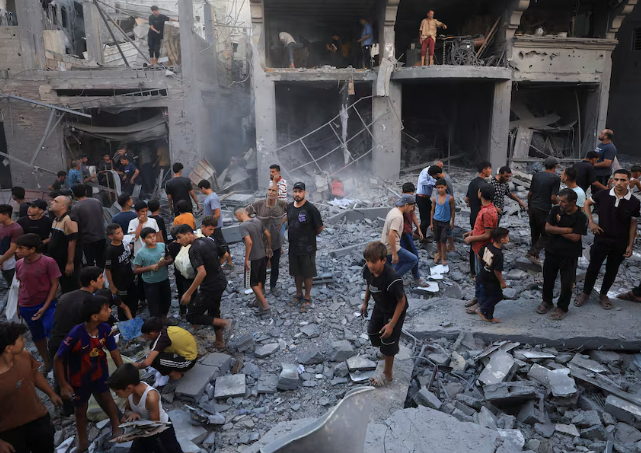
Israeli attacks across the Gaza Strip have killed five Palestinians, including a 12-year-old boy, amid continued accusations by Israel and Hamas of ceasefire violations. The truce came into effect in October 2025, following two years of conflict.
Mahmoud Bassal, spokesperson for Gaza’s Civil Defence agency, said the boy was killed by Israeli gunfire east of Al-Bureij refugee camp in central Gaza.
Two other Palestinians were killed in separate Israeli strikes near the town of Al-Zawayda, several kilometres away, Bassal added. Al-Aqsa Martyrs Hospital confirmed that all three victims were brought to the facility dead.
In southern Gaza, a woman was shot dead by Israeli forces near Khan Yunis, according to Bassal. Nasser Hospital in the city also confirmed her death.
Later, another Palestinian was killed and several others wounded in an Israeli drone strike west of Gaza City, Bassal said.
The Israeli military said it had targeted what it described as “terrorists” in the Al-Zawayda area and west of Gaza City. It added that it was investigating reports about the Palestinian woman killed near Khan Yunis.
According to Gaza’s Health Ministry, which operates under Hamas authority, Israeli forces have killed more than 1,600 Palestinians since the ceasefire was announced a year ago. The United Nations considers the ministry’s casualty figures reliable.
The Israeli military has reported seven deaths among its ranks during the same period, along with the death of one civilian contractor.
Meanwhile, Israeli settlers have moved into eight houses near the occupied West Bank city of Jericho, claiming they were legally purchased. Palestinian officials, however, have rejected the claim, alleging that the documents used to support the transaction were forged.
Families, including children, were seen moving into the properties on the outskirts of the ancient city, raising concerns among Palestinians about a possible increase in Israeli military presence and settler violence in the area.
Hanan Greenwood, a representative of the settler community, said Israeli families had moved into eight houses outside Jericho on Wednesday, near the archaeological site known as the Hasmonean Palaces.
Greenwood, who represents settlers in the area, said the properties had been acquired with the assistance of Nachala, a right-wing Israeli organisation that supports the establishment of new settlements in the West Bank and advocates the territory’s annexation by Israel.
More than 500,000 Israeli settlers live in settlements across the occupied West Bank, which are considered illegal under international law. The territory is also home to more than three million Palestinians, who regard it as a key part of a future Palestinian state.
Hussein Hamayel, governor of the Jericho region, said the disputed land belonged to the Palestinian Authority and could not legally be sold. He described the documents being circulated as forged and dismissed the settlers’ claims as propaganda.
The properties are located in Area C of the West Bank, which, under the Oslo Accords signed in the 1990s, remains under full Israeli control. Israel has occupied the West Bank since 1967.
Israeli settlement monitoring group Peace Now said around 30 settlers arrived at the houses on Wednesday. The organisation alleged that during the takeover, settlers assaulted and robbed two Israeli activists and shot a Palestinian man in the leg.
Peace Now warned that establishing a settler presence close to Palestinian residential areas could lead to further displacement and tensions. It cited Hebron, where around 400 Israeli settlers live in the Old City alongside approximately 250,000 Palestinians, as an example of the consequences of settlement expansion.
The organisation said the Israeli presence in Hebron had contributed to recurring clashes, restrictions on Palestinian movement and the displacement of thousands of residents.
It further stressed that even if the properties had been purchased legitimately, the Israeli government retained the authority to decide whether the settlement could be established.