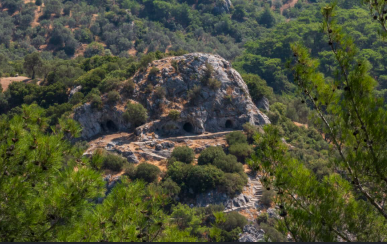
A cave on a hillside overlooking the olive-covered countryside near Izmir has renewed debate over whether it was once associated with the ancient Greek poet Homer, who is traditionally credited with writing The Iliad and The Odyssey.
Known locally for generations as Homer’s Valley, the site has long been linked to the poet, although there is no conclusive evidence establishing that Homer actually wrote his epics there.
Turkish researcher Altan Altin, who has written a book on the subject, said local residents had traditionally identified the cave as the place where Homer composed his poems.
The debate over Homer’s origins has gained fresh attention following the release of Christopher Nolan’s film The Odyssey. Homer has long been associated with the Izmir region, known in antiquity as Smyrna.
Second-century Greek geographer and historian Pausanias referred to a grotto near the springs of the Meles River in Smyrna, saying it was believed to be the place where Homer composed his works. His account has contributed to centuries of speculation about the poet’s life and origins.
The cave, however, is difficult to access and its walls contain Greek inscriptions of uncertain age.
While the Greek island of Chios also claims links to Homer, supporters of the Izmir theory point to historical and archaeological evidence connecting the poet with ancient Smyrna and the surrounding area.
Altin argued that a third-century BC relief depicting the deification of Homer contains details that closely resemble the cave and its surrounding landscape. He said the discovery provided an important geographical clue supporting the theory that Homer was connected to Bornova.
Archaeologist Mehmet Akif Erdem also pointed to archaeological discoveries from the area, including coins bearing Homer’s image, as evidence that the people of ancient Smyrna regarded him as one of their own.
He noted that The Iliad and The Odyssey were written using Ionic and Aeolic Greek dialects, which could indicate links to Smyrna, Bornova and the wider ancient region of Ionia.
Homer’s presence is also reflected throughout Bornova, where a bust of the poet stands at Yesilova Hoyuk, one of Izmir’s oldest known prehistoric settlements.
The town already hosts a book fair dedicated to Homer and has a statue of Hector, the Trojan War hero. Local authorities are also planning to restore the cave and open it to visitors amid renewed international interest in the ancient poet.
Bornova Mayor Omer Eski said preserving Homer’s legacy was a responsibility and argued that the poet’s stories were closely connected to the region.
However, the site has also become the subject of a political dispute. In 2024, municipal officials affiliated with President Recep Tayyip Erdogan’s ruling AKP proposed changing the name of Homer’s Valley to honour a Turkish fighter.
The mayor opposed the proposal, saying removing Homer’s name would damage Bornova’s historical identity.
Meanwhile, the success of Nolan’s film has sparked renewed interest in Homer’s works in Izmir, with local booksellers reporting increased sales of The Odyssey.
Altin said Homer’s writings contained cultural references and descriptions that suggested he was closely connected to Anatolia.
He argued that the question of Homer’s origins should not become a source of tension between Türkiye and Greece, noting that Homer lived around 2,800 years ago, while the modern Turkish-Greek border is only about a century old.