
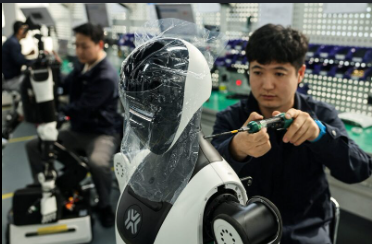
Over the past decade, robotics competitions in China have evolved from small academic events into major showcases of the country’s rapidly expanding robotics industry, reflecting the sector’s growing strategic importance under President Xi Jinping.
Initially organized by academic teams, hobbyists, industry groups and local governments, the competitions largely featured university teams and experimental machines. Today, they have become high-profile events promoted by state media and increasingly used by companies to demonstrate the commercial potential of their technologies.
The latest and largest event, the five-day World Humanoid Robot Games, began in Beijing on Saturday.
China’s robotics competitions initially received support from industry associations and the Fujian provincial government. Early events featured relatively simple machines, including small wheeled robots programmed to play football while avoiding collisions and locating the ball.
The sector gained national prominence in 2015, when Beijing hosted the first World Robot Conference. A year earlier, Xi had described robotics as the “crown jewel” of advanced manufacturing, according to state media.
At the 2015 exhibition, mobile robots demonstrated their ability to play badminton by tracking shuttlecocks and returning shots. While the displays attracted public attention, the technology remained largely experimental.
Many of those machines relied on image-based distance sensors developed during the 2010s, along with object-tracking technology that dates back decades.
By 2023, the World Robot Conference had developed into a major platform for established companies to showcase new technologies and attract attention to their products. At the same time, China’s advantage in producing relatively low-cost robotic systems became increasingly apparent.
Xiaomi’s robotic dog, CyberDog, for example, attracted crowds when it was introduced as a relatively affordable platform for developers and enthusiasts. It was priced at around $1,500, compared with more than $75,000 for Boston Dynamics’ Spot quadruped robot.
The development of humanoid robots has accelerated further in recent years. In April 2025, humanoid robots competed alongside human runners in Beijing’s first robot half-marathon. Engineers accompanied the machines throughout the race, with only a fraction completing the course. Several robots collapsed shortly after the start, while others crashed into barriers.
A year later, the technology showed significant progress. A Unitree H1 humanoid robot completed the final stretch of the second Beijing half-marathon without human assistance.
State media reported that 47 of more than 100 robot teams entered in 2026 completed the competition.
Among the most notable performances was that of “Flash,” a humanoid robot developed by Chinese smartphone maker Honor, which completed the half-marathon autonomously in 50 minutes and 26 seconds.
Analysts and industry executives have linked the rapid advances to China’s expanding robotics supply chain, government support and declining component costs.
Government policy has played a significant role. Beijing’s 2021 five-year plan for the robotics industry included subsidies, tax incentives for research and financing support, while setting an ambition for China to become a global hub for robotics innovation.
The 2026 World Humanoid Robot Games have also introduced competitions focused on robotic hands, testing machines on precision tasks such as tightening screws, opening bottles and picking up beads with tweezers.
Experts say developing robotic hands capable of matching the precision and sensitivity of human hands remains one of the biggest engineering challenges in creating commercially useful humanoid robots.
The shift from demonstrations and sporting competitions toward practical tasks highlights the industry’s broader challenge: proving that increasingly advanced humanoid robots can move beyond prototypes and perform reliably in real-world workplaces.