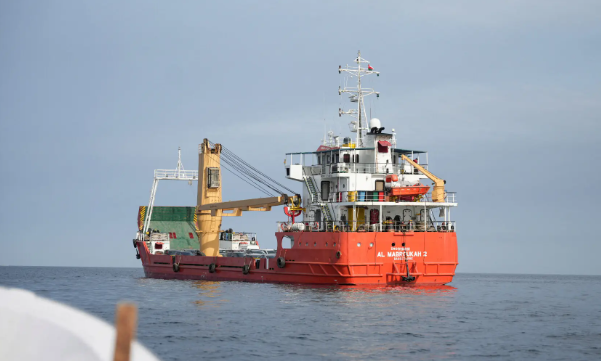
Around 12 to 15 per cent of global maritime trade, valued at more than $1 trillion, passes annually through the Red Sea corridor stretching from the Suez Canal in the north to the Bab el-Mandeb Strait in the south. Disruptions along the route are now adding to pressure on Middle Eastern crude supplies.
A new risk has emerged after Iran-backed Houthi forces seized Yemen’s port of Mocha, raising concerns that shipping through both the Gulf and Red Sea could face simultaneous restrictions.
With the Strait of Hormuz blocked, Saudi Arabia, the world’s largest crude oil exporter, has relied heavily on the Bab el-Mandeb to move oil from its Red Sea terminal at Yanbu. The route connects Asia with Europe through the Red Sea and the Suez Canal.
Houthi attacks on Saudi targets and the capture of Mocha port have further complicated efforts to maintain Saudi oil exports. According to the International Energy Agency (IEA), Saudi Arabia’s crude supply fell by 2.3 million barrels per day (bpd) in August to around 6 million bpd, its lowest level in more than three decades. Saudi Arabia also reported to the Organisation of the Petroleum Exporting Countries (Opec) that its crude production dropped to its lowest level since 1990.
The IEA said the decline followed attacks by groups linked to the Houthis on vessels using the Bab el-Mandeb, as well as strikes targeting Saudi Arabia’s Jazan refinery and shipping activity near Yanbu. Iran-backed groups in Iraq also used drones to target Saudi Arabia’s Abqaiq oil processing facility.
Saudi Arabia last Friday announced the temporary closure of its key East-West crude oil pipeline as a precaution after multiple attacks. The Saudi oil ministry said the pipeline had been targeted in the Riyadh and Madinah regions.
The East-West pipeline has become increasingly important since the outbreak of the war involving Iran and the subsequent closure of the Strait of Hormuz. Saudi Arabia has been using the pipeline to transport millions of barrels of crude from its eastern oil fields to Yanbu on the Red Sea, allowing exports to continue while bypassing Hormuz.
An earlier Aramco report said around 7 million barrels of crude were being transported to Yanbu, with approximately 5 million barrels exported to international customers. The alternative route had helped Saudi Arabia maintain a significant level of crude exports despite the disruption in Hormuz, but it is now facing growing security risks.
Oil markets have responded to the worsening situation. WTI crude futures ended Friday at around $100.05 per barrel, while Brent crude settled between approximately $104.23 and $104.85. Prices had surged to nearly $109 per barrel late Thursday, reflecting concerns over the continuing US-Israel conflict with Iran and the widening regional tensions.
Oil prices later eased after reports that Middle Eastern foreign ministers were seeking a temporary arrangement with Iran to facilitate tanker movements through the Strait of Hormuz. UBS energy analyst Giovanni Staunovo said the possibility of renewed diplomatic talks had put some downward pressure on prices.
Shipping activity through Hormuz remains significantly below normal levels. The number of vessels passing through the strait fell to seven on Thursday from 11 a day earlier, compared with a recent 10-day average of 15 vessels. Before the war began on February 28, around 125 commodity vessels passed through the strait, which normally handles about one-fifth of global daily oil and liquefied natural gas supplies.
The attacks on Saudi oil infrastructure have raised concerns that Middle Eastern crude supplies could fall further. Damage to the East-West pipeline could potentially put 3 to 4 million bpd of Saudi crude exports at risk.
Saudi Arabia’s crude exports have already declined. The country reported to the Opec Secretariat that its oil production stood at 6.24 million bpd in August. The IEA has warned that normal oil flows from the Middle East may not resume until 2027 and expects global oil supply to decline more sharply this year than previously projected.
Market sentiment has consequently turned increasingly bullish.
RBC Capital Markets analyst Helima Croft told Reuters that Brent crude could rise above $120 per barrel by the end of the year if fighting in the Middle East continues.
Several major banks, including Goldman Sachs, Bank of America, HSBC and Commerzbank, raised their Brent crude price forecasts last week as continued disruptions to Middle Eastern shipping tightened markets and pushed oil prices to multi-week highs.
Commerzbank raised its year-end Brent forecast to $85 per barrel from $75. Goldman Sachs also increased its Brent and WTI forecasts by $5 per barrel for December 2026 and 2027, citing expectations that shipping disruptions in the region could continue into next year.
Goldman Sachs said Brent could exceed $120 per barrel if Gulf oil production in 2027 remains 4 million bpd below pre-war levels, compared with its base-case estimate of a 500,000-bpd shortfall.
Bank of America warned that further disruptions could push crude prices towards $120 per barrel, while extensive damage to energy infrastructure could drive prices as high as $150 per barrel. Its central outlook assumes that oil flows through Hormuz will gradually recover and that a prolonged conflict will be avoided.
For Pakistan, the developments raise concerns about another increase in domestic fuel prices in the coming weeks, as prolonged disruptions to global oil supplies could increase import costs and add to inflationary pressures.