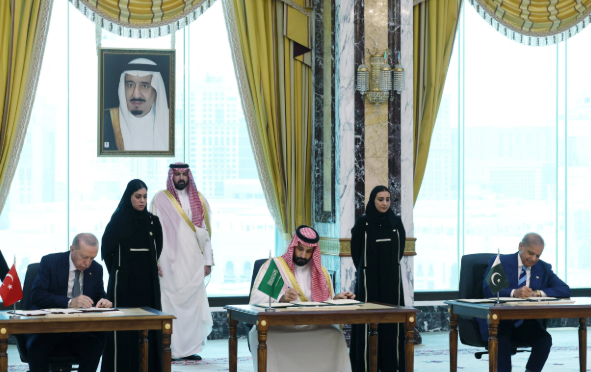
Bangladesh’s growing economic dependence on the Gulf has become increasingly evident amid regional conflicts and disruptions, with the country now considering whether to join the Makkah Joint Defence Agreement signed by Saudi Arabia, Türkiye and Pakistan on August 7.
Around three-quarters of Bangladeshis who travelled abroad for employment between fiscal years 2015 and 2025 went to the Middle East, while nearly half of the country’s remittances originate from the six Gulf Cooperation Council (GCC) states.
Foreign Minister Khalilur Rahman has told parliament that the government would respond positively if invited to join the agreement. However, any decision to participate could also provide Dhaka with an opportunity to negotiate economic and labour-related commitments with Saudi Arabia.
Potential priorities include stronger protections for Bangladeshi migrant workers, skills development, energy security and increased investment.
Saudi Arabia has indicated that the agreement remains open to additional members. Bangladesh already participates in a Saudi-led maritime alliance involving 14 countries covering the Red Sea and Gulf of Aden. On September 2, Bangladesh’s defence adviser also discussed expanding military training exchanges and cooperation on disaster management with the Saudi ambassador.
Prime Minister Tarique Rahman is also expected to visit Riyadh following an invitation from Saudi Crown Prince Mohammed bin Salman, as the two countries seek to deepen bilateral ties.
A key priority for Dhaka should be safeguarding the employment and welfare of Bangladeshi workers in the Gulf.
According to the Bureau of Manpower, Employment and Training (BMET), more than 969,000 Bangladeshis travelled abroad for employment in fiscal year 2025-26, the lowest figure in five years.
Saudi Arabia remains one of the few major Middle Eastern markets actively recruiting Bangladeshi workers, although its labour demand is undergoing changes. Saudi Arabia’s Public Investment Fund has reduced or postponed several large-scale projects under its 2026-30 strategy, with some project budgets reportedly cut by as much as 60 per cent.
The growth in registered construction workers in Saudi Arabia also slowed sharply, from 32 per cent in 2025 to 6 per cent during the first quarter of 2026.
A World Bank study has found that more than 60 per cent of Bangladeshi migrants work in the construction sector, making them particularly vulnerable to changes in Saudi infrastructure spending.
An employment agreement signed between Bangladesh and Saudi Arabia in October 2025 promised stronger worker protections, guaranteed wages and improved welfare measures. Dhaka could seek clear implementation targets and greater opportunities for skilled workers under any new arrangement.
Bangladesh’s labour strategy may also need to shift from low-skilled employment towards higher-paying occupations.
Saudi Arabia requires many low-skilled foreign workers to pass the Takamul skills verification process before being hired. Following the introduction of the requirement in October 2025, the number of Bangladeshi workers departing for Saudi Arabia reportedly fell by 18.46 per cent.
Bangladesh currently conducts skills assessments for around 60,000 workers each month through 28 centres. While the system has expanded, much of the financial burden falls on workers, who pay about $50 for each test.
Dhaka could seek Saudi financial support for skills training, testing and certification programmes. Such cooperation could also help Bangladeshi workers move beyond traditional construction jobs.
The growing demand for data centres and cloud infrastructure in the Gulf could create opportunities for Bangladeshi network engineers, IT technicians and other technology professionals. A joint digital skills programme could help expand employment opportunities in these higher-skilled sectors.
Energy security is another major concern for Bangladesh. Recent supply pressures have highlighted the risks associated with relying on long-term gas arrangements.
Dhaka has secured $3.3 billion in financing from the Jeddah-based International Islamic Trade Finance Corporation to fund fuel, gas and fertiliser imports during the current fiscal year.
Although Saudi Arabia does not supply gas to Bangladesh, Saudi Aramco provides crude oil to the Bangladesh Petroleum Corporation. Saudi Arabia is also the largest shareholder in the Islamic Development Bank Group, which includes the trade finance institution.
Dhaka could therefore seek deferred-payment arrangements for crude oil imports and access to more affordable Islamic trade financing as part of efforts to strengthen energy security.
Any closer alignment with Riyadh would also require Bangladesh to protect its interests in other Gulf states.
More than one million Bangladeshis live in the United Arab Emirates, where visa processing for many categories of Bangladeshi applicants has remained largely restricted since 2024. Remittances from the UAE also declined by more than 10 per cent in 2025 to $4.16 billion.
Dhaka may therefore need to maintain strong relations with Qatar, Kuwait, Oman and the UAE alongside any expanded partnership with Saudi Arabia. Restoring normal visa processing in the UAE could be an immediate priority.
The government has sought to ease concerns over the possible foreign policy implications of joining the Makkah Pact, with the Foreign Ministry describing the agreement as an internal Muslim matter and saying it does not pose a foreign policy risk.
However, closer ties with Riyadh would require Bangladesh to maintain parallel diplomatic engagement across the Gulf to protect its labour, energy and economic interests. Vital gas supplies from Qatar and Oman should also remain insulated from any new strategic arrangements.
For Bangladesh, the potential benefits of closer cooperation with Saudi Arabia extend beyond defence. The country’s large migrant workforce has played a significant role in supporting the domestic economy through remittances, while Bangladeshi workers have contributed substantially to Gulf infrastructure development.
If Dhaka decides to join the Makkah Pact, securing concrete commitments on employment, worker protection, skills development, energy supplies and investment could help ensure that the agreement also serves Bangladesh’s broader economic interests.