
hristianity’s presence in South Asia predates colonial modernity by many centuries and its story in what is today Pakistan cannot, and should not, be understood solely through the lens of empire.
According to long-held tradition among the St Thomas Christians of southwestern India, the apostle Thomas, one of the original 12 disciples of Jesus Christ, arrived at the Malabar Coast (present-day Kerala) around 52 CE, establishing Christian communities that have endured for nearly two millennia.
While the historicity of Thomas’ journey remains debated, there is broad scholarly consensus that Christian communities have existed in the Subcontinent since at least the early centuries of the Common Era and were integrated into wider Eastern Christian networks centred in West Asia, particularly through Syriac-speaking churches linked to Persia and Mesopotamia.
Long before the arrival of European powers and their ecclesiastical institutions, these early South Asian Christian traditions evolved in dialogue with local languages, poetic forms and musical sensibilities.
The making of a vernacular Christian tradition
From the 16th century onwards, the arrival of Portuguese, Dutch and, later, British missionaries significantly expanded Christianity’s demographic and institutional presence, gradually extending it into northern India and regions that would eventually form Pakistan.
During the British colonial period, especially in the late 19th and early 20th centuries, Christianity took root most visibly among marginalised and oppressed communities, particularly the Dalits — so-called ‘low-caste’ Hindu groups in Punjab and Sindh. Scholars widely agree that the overwhelming majority of Pakistani Christians today trace their ancestry to these mass conversions, undertaken not merely as acts of faith but as responses to entrenched caste hierarchies, social exclusion and economic exploitation. For many, conversion represented the promise, if not always the fulfilment, of dignity, education and social uplift.
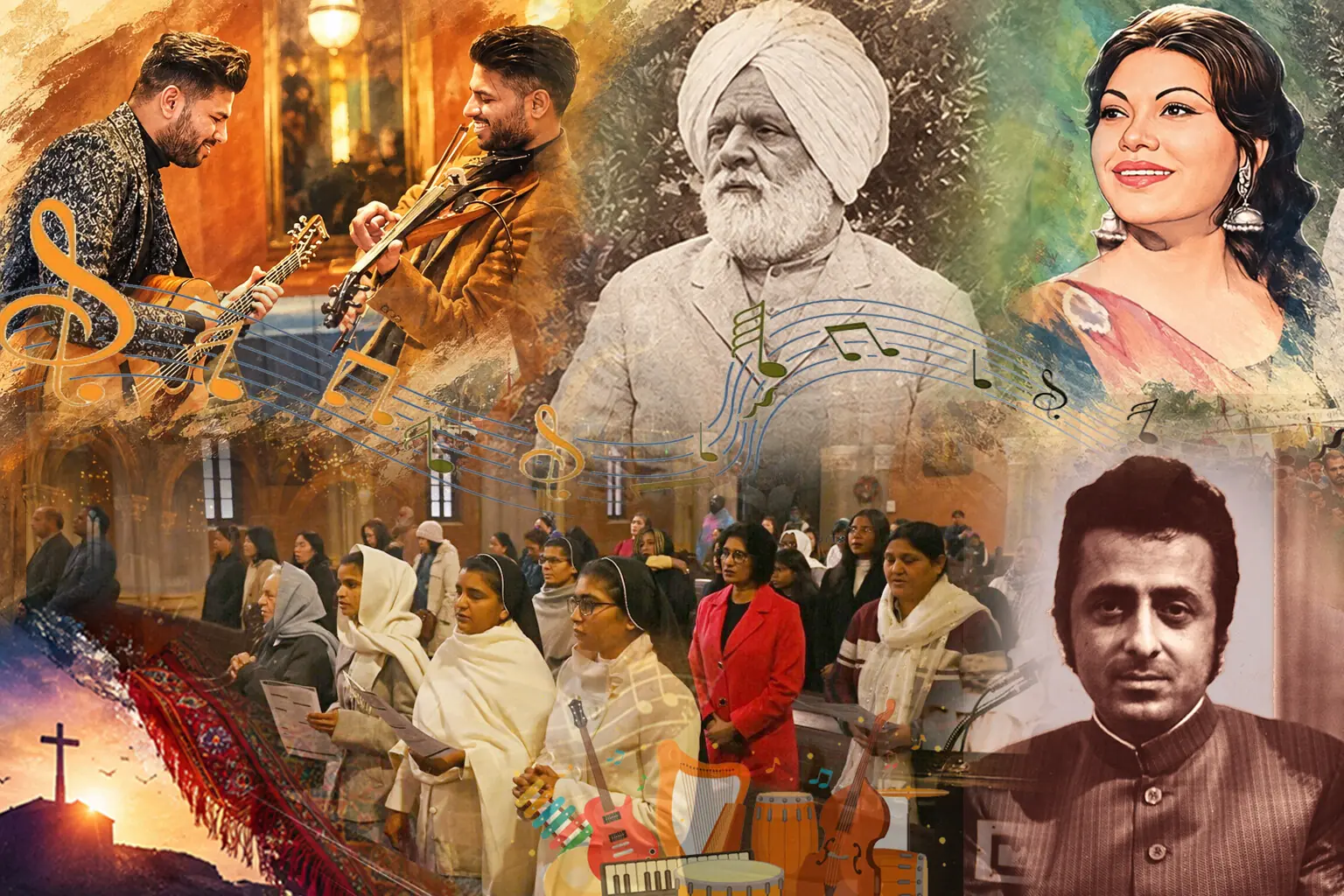
This social history is crucial to understanding the development of Christian music in Pakistan. Unlike the courtly or classical traditions of the West, church music here emerged largely from village congregations, mission schools, urban settlements and labouring communities, where biblical texts were sung in Punjabi, Urdu, Sindhi and later Siraiki, often set to familiar melodic modes and rhythmic cycles.
From its earliest stages, Christian musical expression in the region developed in close conversation with its surroundings, absorbing influences from folk idioms, Sufi devotional practices and South Asian poetic metres, while gradually shaping a distinct sacred repertoire