Article
BRICS, the IMF, and Pakistan
By: Naeem Masood
Friends and associates are starting to look less like companions and more like researchers. Altaf Hussain Hali once engraved a voice coming from Hazrat Yusuf’s well in a remarkably wise manner: “Few are the friends here, but ‘brothers’ in abundance.” Whatever brothers may do, friends need to step forward and play a bolder game. As Shad Azimabadi rightfully asserted: “To him belongs the goblet who rises and claims it first.”
Gentlemen! Whether someone is an accountant or an economist is not a sufficient debate; whether one is a devotee of democracy or an admirer of autocracy is not enough either. Allama Muhammad Iqbal provided the ultimate roadmap by summarizing the essence of all his philosophy a roadmap that requires a discerning eye to truly comprehend: “tairay Ishq me Intiha Chahta hun / meri sadghi dekh Kia chahta hun” in other words, I seek the ultimate height of your love / Behold my simplicity, what is it that I ask? This, what I want does matter.
As for economics, if one truly wants to understand the distinction between an accountant and an economist, Paul Samuelson and William Nordhaus’s classic textbook puts it succinctly: “Economics studies how societies use scarce resources, while accounting is the financial recording of transactions derived from those resources.”
Anyhow, to some here, the International Monetary Fund (IMF) is a savior; to others, a hunter. Whatever the IMF may be, the real question we must ponder is: “What are we?” Do our actions reflect a devotion to the hunter, or are they a quest for salvation?
Even if we accept Nobel Laureate Joseph Stiglitz’s view that “IMF-imposed austerity policies and tight fiscal controls often worsen economic crises in developing nations, thereby escalating the troubles of the poor,” we must still engage in self-reflection. Did this economic hunter leap at us on its own, or did we gravitate toward the IMF due to our own conduct, the favors of the elite, and a collective lethargy?
According to former IMF chief and former President of the European Central Bank Christine Lagarde, “Economic stability is the most fundamental prerequisite for poverty reduction. Crisis prevention is the single greatest service the IMF can render to developing nations.”
The question then arises: in a land endowed with fertile soil, agricultural diversity, rivers, mountains, abundant crops, and orchards blessed with merciful rains, hard work, and skilled labor if we still end up trapped in the clutches of an economic hunter, what does it mean? Quite simply, it means the elite are thriving while the delivery of resources to the common man is fundamentally flawed. Workers and farmers are deprived of basic human rights while the elite hoard everything. Constitutions everywhere look attractive on paper, but ensuring their benefits reach the average citizen remains difficult. We must ask: who stands as the obstacle? If these obstacles are eliminated, everything will flourish; otherwise, life remains an ongoing agony. It is essential to transition from the individual to the collective: analyzing a single tree through the lens of microeconomics, and evaluating the entire forest through macroeconomics, so that the garden’s enterprise may thrive under a steward who is both accountant and gardener.
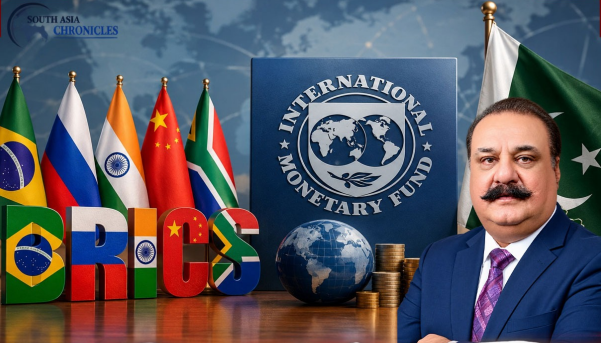
In reality, developing nations must understand their own position and forge their own pathways toward economic success and prosperity. In this context, the “BRICS” model appears highly beneficial. It emphasizes bilateral trade across borders using local currencies instead of the US Dollar, and offers an alternative institution in the New Development Bank (NDB). Furthermore, BRICS presents a coordinated framework for economic, commercial, educational, and technological cooperation among developing member states.
To recall, the term BRIC was coined by Jim O’Neill in 2001, expanding to BRICS around 2010–2011. Initially comprising Brazil, Russia, India, and China, it later welcomed South Africa. The inaugural BRIC summit took place in Russia in 2009, though foreign ministers of the initial four countries had already met on the sidelines of the UN General Assembly in September 2006. Today, it stands as a prominent international forum representing emerging economic powers. All permanent members of BRICS Plus possess veto power. Additionally, there are “Partner Countries” that, while lacking veto power, still enjoy economic benefits and participate in summits. Ten nations currently serve as Partner Countries: Belarus, Bolivia, Cuba, Kazakhstan, Malaysia, Nigeria, Thailand, Uganda, Uzbekistan, and Vietnam. Notably, admitting a new permanent member or partner country requires absolute unanimity among the 11 permanent members.
The presence of the letter ‘B’ from the Americas gives BRICS significant economic and diplomatic weight, just as Iran’s inclusion in BRICS Plus holds deep geopolitical meaning. This truly breaks the undue monopoly of the West. Pakistan, too, should leverage backdoor diplomacy to become a partner country in general, and a full member in particular, of BRICS Plus.
India needs to do two things: first, tone down its rivalry with China; second, refrain from creating obstacles in Pakistan’s path to membership. A shift in Indian thinking would not only benefit South Asia and SAARC, but would also generate natural economic stability worldwide, challenging the dominance of developed nations. Instead of conflict, the region would experience harmony and constructive growth. The NDB could bring about a paradigm shift for the people of developing countries.
Pakistan sought BRICS Plus membership in 2023, but India blocked its path, stalling promising avenues for peace, prosperity, and development. China and Russia nevertheless extended their support to Pakistan. If Pakistan joins for the sake of regional peace and global cooperation, having all nuclear-armed states of the region within the forum could channel nuclear energy toward positive uses opening the door to a vibrant industrial revolution and strengthening the global economic balance. The closeness of Pakistan with BRICS plus may be a wonderful reason for regional and global peace, and this intimacy can also open a great avenue for the BRICS community and reduce the US importance as well in many cases. Pakistan has to increase diplomatic professionalism from general to soft power and education diplomacy. If strategic planners put the ears on the talk of the town it would be a great achievement for all.