
Article
The Long March, Charter of Democracy, and Magna Carta!
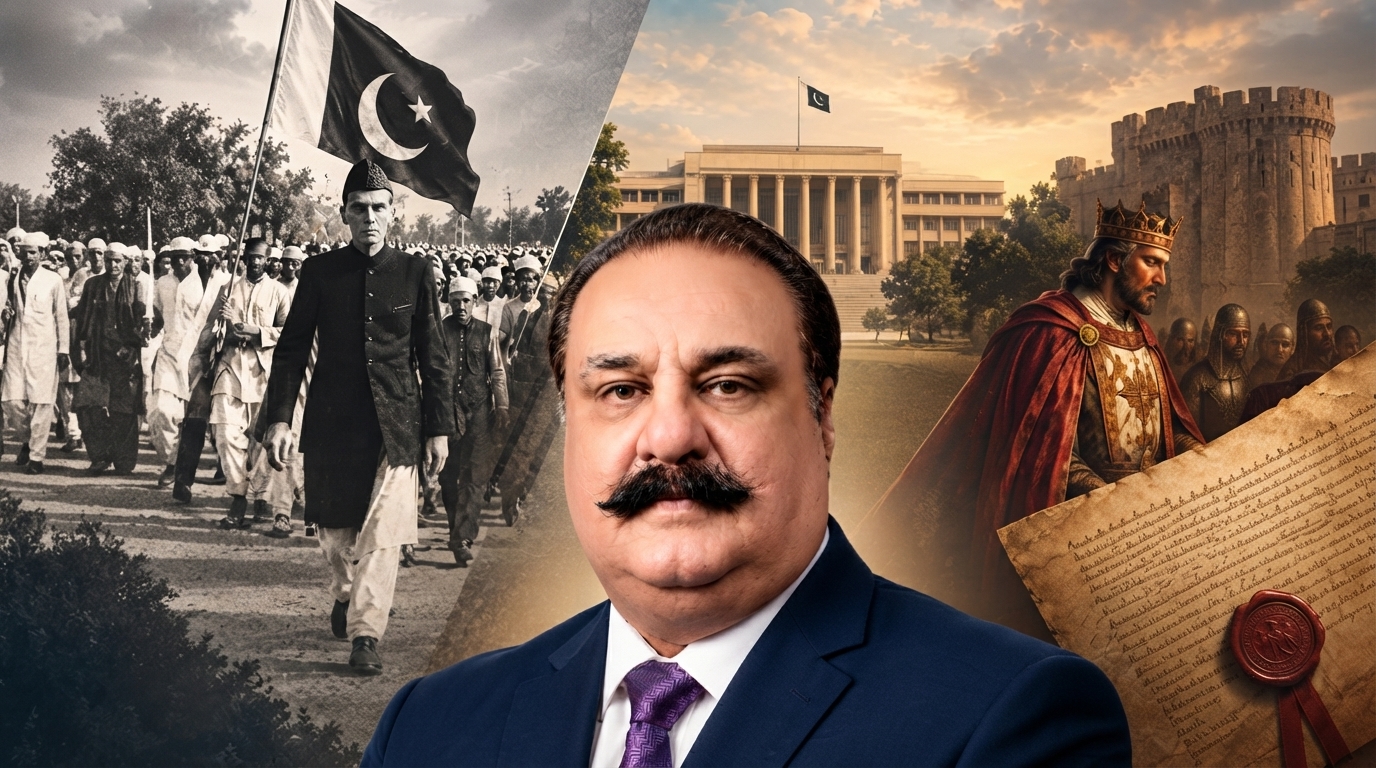
By: Naeem Masood
It is precisely its intrinsic splendor and vitality that endow it with the status of a living document. Rather than empowering a single element or a select few classes, its sheer breath and foresight transform the entire state into a cradle of institutional equilibrium. This, indeed, is the Constitution!
What, then, is a State? A state is that institutional totality organized within a specific geographical territory, possessing political, legal, and external sovereignty. When we speak merely of a “country,” however, we refer simply to a piece of geography and its distinct local culture.
Moving beyond these two foundational tenets of political science, we need not look far. Consider merely the opening 26 years of the twenty-first century: as we stepped into this era, military authoritarianism had sunk its claws deep across the state. relief arrived at long last in 2006, when Benazir Bhutto and Mian Nawaz Sharif forged the historic Charter of Democracy (CoD) a document endorsed even by the founder of Pakistan Tehreek-e-Insaf (PTI). In Chapter 8 of his autobiography, Pakistan: A Personal History (published in 2011), he explicitly concurs with the Charter’s provisions regarding democracy, constitutional strengthening, and judicial independence. He affirmed his endorsement during press conferences in London and Islamabad throughout 2006 and 2007, subsequently joining the All Parties Democratic Movement (APDM) on this very premise.
Later, as the PTI chairman’s political stance solidified, he repeatedly asserted that the PPP and PML-N were misusing the Charter of Democracy purely to secure a National Reconciliation Ordinance (NRO). Yet, from whichever analytical lens one views the Charter, every single clause reflects democratic resilience and principled politics. In truth, the PTI founder could himself have brandished the intellectual banner of the Charter of Democracy. Does history not quietly ask whether the partisans of Khan (Hamiyan-e-Khan), in their pursuit of power, succumbed to political appetite while depriving themselves of the journey down the highway of reconciliation?
The Charter of Democracy garnered widespread acclaim both nationally and internationally. At the time, political stalwarts including Qazi Hussain Ahmed, Maulana Fazlur Rehman, Asfandyar Wali, Mahmood Khan Achakzai, and Mir Hasil Bizenjo hailed it as commendable and actionable principles that remain thoroughly actionable today.
The Commonwealth Secretariat and the British government observed that agreement among the political leadership on a joint democratic manifesto represented a monumental step toward civilian rule and transparent elections. In May 2006, the US State Department voiced its encouragement, stating: “We commend the strengthening of democratic stability and peaceful dialogue among all political forces in Pakistan.” Global media outlets such as the BBC and The Guardian characterized the pact in their analyses as “Pakistan’s Magna Carta,” celebrating Benazir Bhutto and Nawaz Sharif’s willingness to bury past bitter rivalries as an act of profound democratic statesmanship.
To be sure, the Magna Carta of 1215 replaced the “Law of the King” with the “Rule of Law”a historic British accord that served as the first major effort to curb absolute power, remaining to this day a timeless symbol of fundamental rights, judicial safeguards, and constitutional supremacy.
Today, amid echoing discussions surrounding PTI’s proposed long march, potential emergency declarations, and the imposition of Governor’s Rule in Khyber Pakhtunkhwa, democratic culture and state stability demand that all these anxieties be re-examined at a single table. As these lines are being penned, there are indications of a dialogue led by the Speaker of the National Assembly involving leaders from both sides of the aisle. The opposing factions must channel this initiative into true democratic thought; this alone reflects political, democratic, and state maturity.
It is undeniable that Articles 232, 234, and 245 of the Constitution mandate rigorous protocols prior to any declaration of emergency or Governor’s Rule. Both the government and the opposition must carefully weigh these constitutional subtleties and realities: is the goal to collapse the democratic chessboard, or to give it endurance?
Mind you, Article 232 opens the window for emergency deliberations strictly on the ground realities of war or severe internal disturbance not otherwise! Article 234 comes into play only when the constitutional machinery within a province has completely broken down, raising the specter of Governor’s Rule. Moreover, the 18th Amendment explicitly stipulates that invoking an emergency in any province requires a resolution from that province’s assembly; failing that, approval from both the Senate and the National Assembly must be secured within ten days! Should the President deem that a province is defying Articles 148 and 149, the chapter of Governor’s Rule may open. Under Article 245, the armed forces may indeed be summoned to restore order in the federal capital or provinces an action that cannot be challenged in a High Court.
Yet why resort to judicial challenges at all? When political leadership is present, passing the ultimate test of statesmanship requires discovering a way out, even from a dead-end alley.
And what constitutes true leadership? Leaders find themselves behind bars and facing the edge of a blade be it in the shape of Zulfikar Ali Bhutto, Benazir Bhutto, Asif Ali Zardari, Nawaz Sharif, or Imran Khan. Even so, personal sacrifices must not be leveraged for political gain; in accordance with the protocol of statesmanship, ultimate survival lies in unyielding loyalty to the state and the Constitution. Leadership is the alignment of word and deed in seeking the nation’s best interests and fostering a cohesive national strategy drawn from the lessons of the state and history!
In this context, Asif Ali Zardari and the PPP’s historic slogan—”Pakistan Khappe” (Long Live Pakistan) cannot be forgotten. Through every era, the PPP has held fierce political and ideological differences with others, and others with them. Yet, who has witnessed the infamous “Sindh Card” played over the past twenty-five or thirty years? The hallmark of the PPP has been its ability to deliver a unanimous constitution, revitalize reconciliation, and breathe life into democracy a lesson the PML-N similarly absorbed through the Charter of Democracy.
All stakeholders of the state must fulfill their constitutional, democratic, and civic responsibilities, especially now that Pakistan has painstakingly built an international reputation as a peaceful, conciliatory state. The Prime Minister’s unequivocal stance at the United Nations reflected this very narrative. Following its recent defensive and diplomatic successes, Pakistan desperately requires economic consolidation which demands that every political force abandon the politics of disruption!