
Article
Suhrawardy: An Constitutional, Intellectual, and Popular Institution?— Part 3
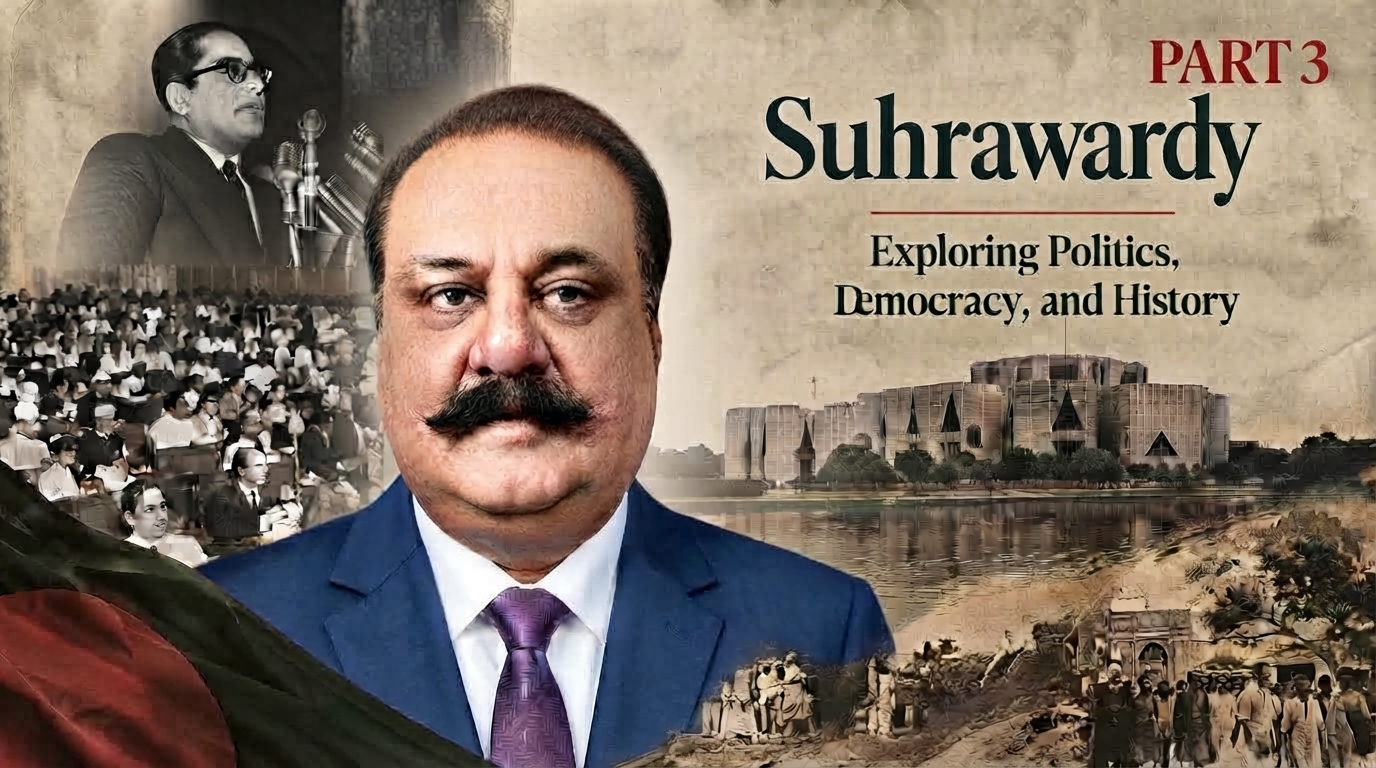
By: Naeem Masood
To be an institution in one’s own right to be the soul of every gathering, whether in an intellectual assembly of friends, a close-knit circle of companions, or a forum of knowledge and wisdom is no simple feat. It is a demonstrative and revelatory declaration of a life defined by continuous striving, unwavering devotion to friends, and absolute commitment to society. It is an educational validation as well! Yet, while such a verified and discerning scholar gains honor and prestige, they must also face the arrows shot from hidden ambushes. It is a dual reality: personal purity on one side, and the ruthless ways of the world on the other.
The lives of leaders are filled with distinct individuality, which is why the common man is compelled to observe them though each sees through their own lens, observe they certainly do. A leader is a subject about which people cannot help but conduct inquiry. Viewed as good by some and bad by others, a leader possesses an intrinsic quality that invites comparison and assessment. Whether a leader stands on the right or the left, the truth remains that they stand! Had they not stood, they would not be a leader. While leaders are constantly compared, the crucial point to reflect upon is that regardless of the inferences drawn or the conclusions reached, leaders are always compared only to other leaders. Remaining steadfast to a narrative or maintaining leadership demands a trial at every step. What a strange spectacle it is: the leader sets the price, bids the price, is sold, and is also the buyer. The difference among these formidable figures emerges when they are encircled by narcissism or overcome by arrogance. Thus, they are not defeated by each other as much as the arrogance and narcissism clinging to them open the doors to their own ruin and collapse.
Sher-e-Bangal A. K. Fazlul Huq (born October 26, 1873; died April 27, 1962) who served for a long period as the Prime Minister of Bengal under British rule, presented the 1940 Lahore Resolution, and later served as Governor of East Pakistan (1956–1958), Interior Minister of Pakistan (1955–1956), and Chief Minister of East Bengal (1954) defeated Khawaja Nazimuddin in his own feudal stronghold in the 1937 provincial elections, a decade before the creation of Pakistan. Khawaja Nazimuddin later served as Governor-General from September 14, 1948, to October 17, 1951 (becoming Pakistan’s second Governor-General following the passing of the Quaid-e-Azam). Subsequently, following the assassination of Liaquat Ali Khan, he served as Pakistan’s second Prime Minister from October 17, 1951, to April 17, 1953 (while Malik Ghulam Muhammad was Governor-General).
A fascinating aspect of history is that Khawaja Nazimuddin, who had been Prime Minister of Bengal prior to Partition, could neither read nor write the Bengali language. He used to deliver speeches written in the Urdu script. According to Suhrawardy’s Political Autobiography (edited by Mohammad H. R. Talukdar and translated into Urdu by Wajahat Masood): “Nazimuddin was a Bengali landlord of Kashmiri origin and was always regarded as a representative of West Pakistan. Maulana Abdul Hamid Khan Bhashani and Sher-e-Bangal A. K. Fazlul Huq were native Bengalis and were considered popular leaders.” Another intriguing leaf of history reveals that when Khawaja Nazimuddin lost to Fazlul Huq, it was observed as noted in Suhrawardy’s autobiography that until he learned Bengali, spoke Bengali, and learned to love Bengal’s culture, he would not be able to win a place in the hearts of the Bengali people. Suhrawardy’s philosophy was similarly grounded: “My identity as a Bengali is a greater reality than my being a Muslim.” Consequently, he immediately learned Bengali and spoke it fluently, although his accent remained somewhat alien; nevertheless, he possessed a deep and sincere sensitivity toward the sentiments of the public. Owing to his long-standing engagement with Bengali politics, wherever he went, the Bengali people welcomed him warmly.
The ‘distinction’ of learning a language existed long before Zulfikar Ali Bhutto, Benazir Bhutto, and Bilawal Bhutto Zardari. When a leader truly becomes a leader, geographical regions and linguistic barriers fade into the background, and the harmony of empathy and genuine affection takes precedence.
It is crucial to understand that from 1947 to 1958, Pakistan operated under a British-style parliamentary model with two Chief Ministers, while East Pakistan and West Pakistan were designated as two provinces. Chief Ministers were elected as heads of government, while Governors represented the Federation. From 1958 to 1969, under the One Unit system (the Ayub era), Governors held dominant administrative power as handpicked appointees of President Ayub Khan, and the office of Chief Minister was abolished. From 1968 to 1971, the positions of Chief Ministers remained suspended; administration rested with the Governors from 1958 to 1969, and under Martial Law from 1969 to 1971, power was held by Martial Law Administrators. Examining the final transitional phase from 1969 to 1971, General Yahya Khan abolished the One Unit scheme in 1970 through the Legal Framework Order (LFO) and restored the former provinces, leading to elections based on one-person, one-vote. However, civilian Chief Ministers were not restored during Yahya’s tenure.
At times One Unit, at times provincial redrawing; authoritarianism under the guise of democracy within presidential setups, and authoritarian styles within parliamentary systems; tension between the Prime Minister and the Governor-General right from the beginning, which later evolved into a cold war between the President and the Prime Minister all of this became embedded in our political culture early on, persisted through subsequent eras, and remains present today. Once again, we find ourselves in a season of debates regarding the creation of new provinces.
In an instant, trial balloons are floated suggesting making Karachi a province, without realizing that Karachi today is a division comprising the South, West, East, Central, Malir, and Korangi/Landhi districts with a population of approximately 20.4 million. Meanwhile, Lahore Division, comprising Lahore, Sheikhupura, Kasur, and Nankana Sahib districts, accounts for roughly 22.8 million people! One cannot help but reflect: if there is ill intent behind creating new provinces, the trial balloon of making Karachi a province is floated first, and as a secondary tactic to derail genuine administrative restructuring, floating the idea of making Lahore a province will follow.
A leadership aiming to strengthen planning through the triangle of reform, innovation, and necessity must first set aside linguistic and personal biases. The leadership at the founding of Pakistan and immediately thereafter failed to do so, and today’s leadership fares no better. Thus, as soon as a preamble of reform is drafted, chapters of contradictions and disputes fly open. Those who merely curse contemporary leadership remain ignorant of foundational history; otherwise, they would know whether the issue lies in the warp or the woof of the fabric. If a disease is identified at its inception and diagnosed in a timely manner, history can be spared many malignant afflictions. Otherwise, like a human illness, history digs its claws in so deeply that civilization itself hangs in the balance, leaving future generations to be born not only into ignorance, an ineffective culture, and a distorted civilization, but also burdened with debt, prejudice, and narrow horizons. When a nation’s historians and teachers act as courtiers, countless obstacles and lethargy stymie its rise.
In the history of the Subcontinent, internal conflicts existed among sons and brothers during the Mughal era, and later between figures like Mahatma Gandhi and Jawaharlal Nehru, manifesting as mega-disagreements. Yet, the leadership or political differences or variations in opinion—between the Quaid-e-Azam and the Quaid-e-Awam were never properly illuminated by any microscope or telescope of our historians. Not every disagreement stems from enmity or hatred; at times, it is not even ideological, but simply a difference in perspective toward a shared destination. Nevertheless, the errors of historians continue to disrupt our political and social fabric. From Khawaja Nazimuddin, Malik Ghulam Muhammad, and General Ayub Khan to General Yahya Khan, were historians denied the freedom to research and verify? If barriers were erected against rigorous inquiry, the risk of historical distortion cannot be ignored!
In the 1950s following the creation of Pakistan, the 1956 Constitution officially declared the country the “Islamic Republic of Pakistan.” While the Muslim League was eager to retain power and adept at deploying religious rhetoric, the feudal majority within the Republican Party evaded agrarian reforms to preserve a status quo that denied transformation in the common man’s life. With the Muslim League as their primary target, immovable mountains of hostility were erected on both sides.
From the very beginning of Pakistan’s journey, national figures burdened democracy under a weight of patronage rather than grounding it in genuine empathy—resulting in a system that alternated between “dictators masquerading as democrats” and “democrats acting like dictators.” Thus, the governance structure has never managed to escape this mirage-like state.
Reading Suhrawardy’s Political Autobiography strongly reinforces the realization that during Pakistan’s early years, the bureaucracy—particularly figures like Ghulam Muhammad and Iskander Mirza—consistently placed obstacles in the path of democracy. In Huseyn Shaheed Suhrawardy’s view, delays in constitution-making failed to provide democratic roots with the necessary sustenance, while the humiliation of elected representatives by dominant elites continuously paved the way for military rule.
A noteworthy historical development was the emergence of the ‘Awami Muslim League’ from the womb of the Muslim League, which eventually took root as the Awami League. Suhrawardy maintained the clear view that until power was transferred to the people’s elected representatives, and until decisions moved out of the palaces of the elite and the establishment into public gatherings and elected assemblies, the country could never achieve stability.
Following General Ayub Khan’s imposition of Martial Law in 1958, politicians were disqualified under the Elective Bodies Disqualification Order (EBDO), and Huseyn Shaheed Suhrawardy was incarcerated. In that climate, a distinct intellectual realization emerged: Suhrawardy’s arrest was viewed directly and indirectly by both the elite and the public not as a personal vendetta, but as an assault on democracy itself. Suhrawardy subsequently etched a unique chapter in history through his defense in the courts.
Ultimately, Suhrawardy remained a bridge and a democratic symbol between East and West Pakistan. Had his efforts to prevent prejudice and division between the two wings been embraced, windows of reconciliation rather than destruction would have opened. Despite his immense popularity in Bengal, promoting national integration remained his core duty. A politics of isolationism was never his method yet that very commitment became his “crime.”
On every Democracy Day each September 15, should the new generation not pause to reflect? Whatever was done is done, and whatever remains is saved but will we remain dedicated to the measures that safeguard democracy and the vision that builds it?