
Article
Suhrawardy: From Constitution Town to Fascism Colony — Part 1
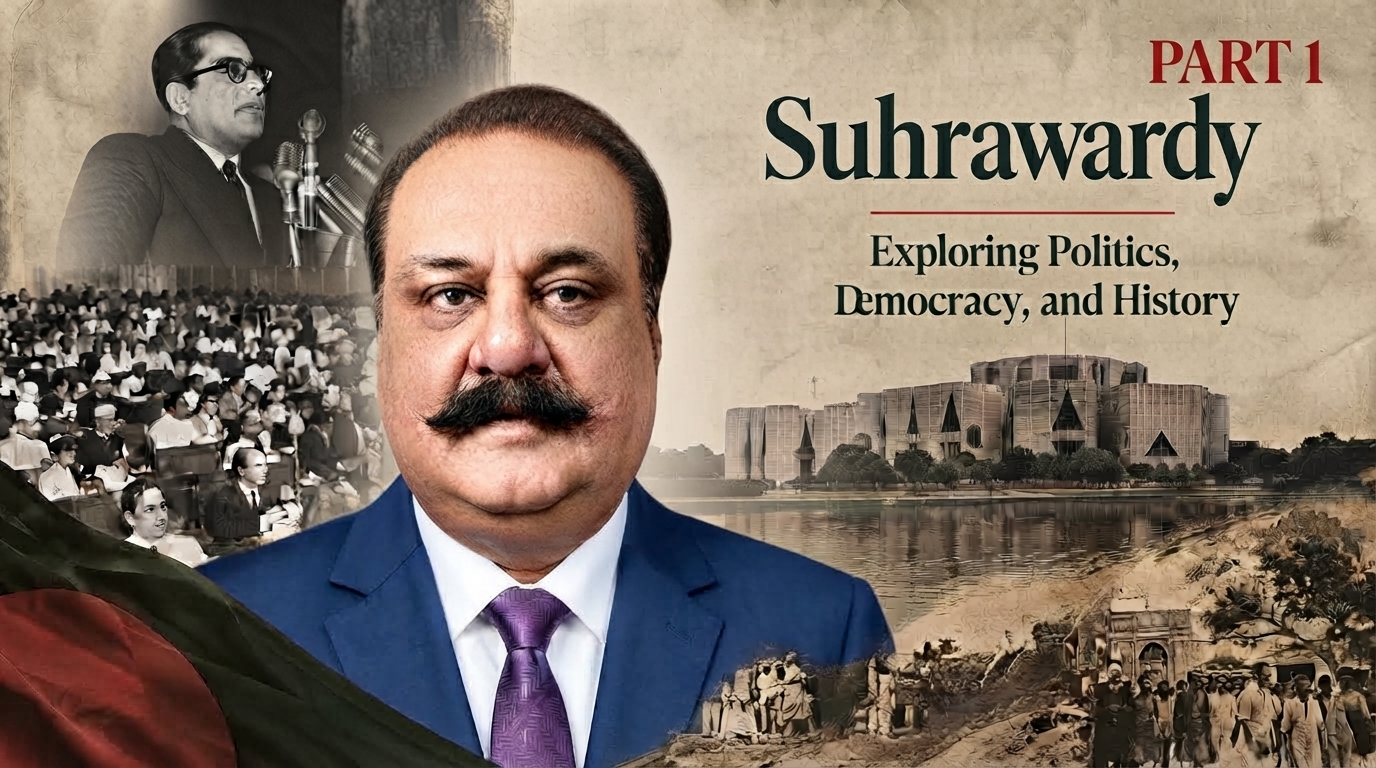
By: Naeem Masood
Their grandfathers were brothers. Regarding his maternal grandfather, history records that he was foremost among those who laid the foundation for the Islamic Renaissance in West Bengal. The ancestral lineage traces back to Iraq. Furthermore, Sheikh Sahib’s genealogy connects to Hazrat Abu Bakr Siddiq through his father’s side, while his mother’s side reaches Hazrat Ali (Karam Allah Wajhah) and Hazrat Fatima-tus-Zahra. Thus, he possessed a hybrid honor of Siddiqi and Syed heritage. His paternal grandfather was a distinguished jurist, while his maternal grandfather was a great spiritual, social, and religious leader. His respected father was also a jurist who served as a High Court judge.
The ancestral forefather who earned initial fame from the city of Suhraward in Iraq was Sheikh Shahab al-Din Umar bin Muhammad al-Suhrawardi, who was counted among the close disciples of Hazrat Abdul Qadir Jilani. Sheikh Shahab al-Din Suhrawardi founded the Suhrawardiyya order of Sufism. His sons and disciples traveled across Iran, Turan, Turkestan, India, Sindh, and Bengal—the preachers of the Suhrawardiyya order reaching the Subcontinent even before the Chishti Sheikhs.
Huseyn Shaheed Suhrawardy (born September 8, 1892, in Midnapore, India; died December 5, 1963, in Beirut, Lebanon), the former Prime Minister of Pakistan (September 12, 1956, to October 17, 1957), was the grandson of Maulana Bahr-ul-Uloom Obaidullah Al-Obeidi (1834–1886). The figure who laid the groundwork for the Islamic Renaissance in West Bengal was conferred the title Bahr-ul-Uloom (Ocean of Knowledge). He excelled not only in Arabic and Persian but also in English. His treatise, “The Mutual Influence of Islamic and European Civilizations,” earned him an award presented personally by Sir Charles Trevelyan. In his era, he had no equal. Al-Obeidi championed progressive ideas and was a devoted admirer of Sir Syed Ahmad Khan’s enlightenment movement, serving among the directors of the Muhammadan Anglo-Arabic College in Aligarh. On September 13, 1879, Al-Obeidi founded the Friends Association, dedicated to the welfare and advancement of Muslims, and placed great emphasis on female education.
Al-Obeidi’s daughter and Huseyn Shaheed Suhrawardy’s mother, Begum Khujasta Akhtar Banu, received home education in English, Arabic, and Persian, becoming the first Muslim woman to pass the Senior Cambridge examination. Her literary work, Aina-e-Ibrat, was an admirable treatise on women’s education that was included in the curriculum of colleges affiliated with Calcutta University. In 1909, Khujasta Akhtar Banu also founded the Suhrawardia Girls’ School, inaugurated by the wife of the Viceroy of India, Lord Minto. Her brothers Al-Obeidi’s sons were also UK-educated law graduates and PhD holders.
Huseyn Shaheed Suhrawardy’s paternal grandfather Aminuddin Suhrawardy, brother of Obaidullah Al-Obeidi was a renowned jurist who served as Sadr-us-Sudur in Bhagalpur, Bihar. Suhrawardy’s father, Barrister Zahid Suhrawardy (Zahid-ur-Rahman), began his professional life in legal practice and traveled to the UK for higher education. Following his retirement from the bench, he was knighted with the title of “Sir.” Notably, after becoming a judge of the Calcutta High Court, he resigned to become a member of the Bengal Legislative Council.
Huseyn Shaheed Suhrawardy served as Pakistan’s fifth Prime Minister (September 12, 1956, to October 17, 1957) and also held the office of Leader of the Opposition from July 7, 1955, to September 11, 1956. Prior to Partition, he served as the Chief Minister of Bengal from April 23, 1946, to August 14, 1947.
History, from the Pakistan Movement through the creation and consolidation of the state, has been a blend of genuine and nominal leadership. Sincere figures and the ruling elite repeatedly found themselves at odds or brought together by necessity yet a willingness to question remained scarce. Asking questions is the first step toward standing tall.
Along this tumultuous path, Sir Barrister Zahid Suhrawardy passed away in 1949 after a prolonged illness. In a stroke of political maneuvering, the Indian government confiscated his entire estate on the pretext of unpaid taxes. Huseyn Shaheed Suhrawardy arrived in Karachi on March 5, 1949. In a display of calculated maneuvering and systemic anxiety, his seat in the Constituent Assembly was declared vacant under the pretext of non-citizenship. Consider this contrast: Babu Raj Kumar Chakraborty, a member of the Assembly who resided permanently in Calcutta, was never deprived of his membership! The very creator of that Assembly was objected to, while no other member faced such scrutiny.
At the time, Huseyn Shaheed Suhrawardy was a leader of immense popular acclaim, a formidable orator, and a former Chief Minister of United Bengal. Upon his arrival in Pakistan, he immediately challenged the monopoly of the ruling elite and began organizing the opposition (the Awami Muslim League). The government feared that if he remained inside the Assembly, he would rally the members from East Pakistan to build a powerful opposition bloc. On the other hand, minority Hindu members like Babu Raj Kumar, though in the opposition, posed no threat of bringing down the Muslim League government or challenging central power. Furthermore, it was widely acknowledged nationwide that Suhrawardy was a diplomat and politician superior to Nehru, and an even greater orator.
In short, by the time Suhrawardy arrived in Pakistan, Muhammad Ali Jinnah had passed away. Consequently, alongside worthy figures, second-tier intellectuals and power-hungry politicians began carving out their share of authority. It felt as if fascism was arriving at the threshold—the knock had been delivered! Did we, right at the outset, allow “Governor-Generalism” to smother the stature of cabinet governance and the dignity of the Constituent Assembly?
These titles and responsibilities are not granted through a magical Open Sesame or an Aladdin’s lamp, nor are they found tucked under a green silk canopy over a shrine. They are forged through cold and warm battles with allies and adversaries alike, won through victory or acquired as spoils. A process is always at work one that may stem from noble action or misrule, or a combination of both. In other words, one secures authority or wears the crown of power only after entangling one’s robes in the thorny bushes along the pathways of democracy and authoritarianism.
The question arises: when a ruler’s governance nourishes one region of a state while leaving another to face catastrophic drought, it generates not only doubt and questioning, but also the seeds of evolutionary and revolutionary movement. It is our misfortune that from the distant past to the present, we have failed to break free from shrine-discipleship, royal subjection, servitude to masters, labor for bosses, and tenant farming under feudal lords. Consequently, we have yet to transition from subjects into citizens, nor have we gathered the courage to ask questions and speak truth to power.
(To be continued)