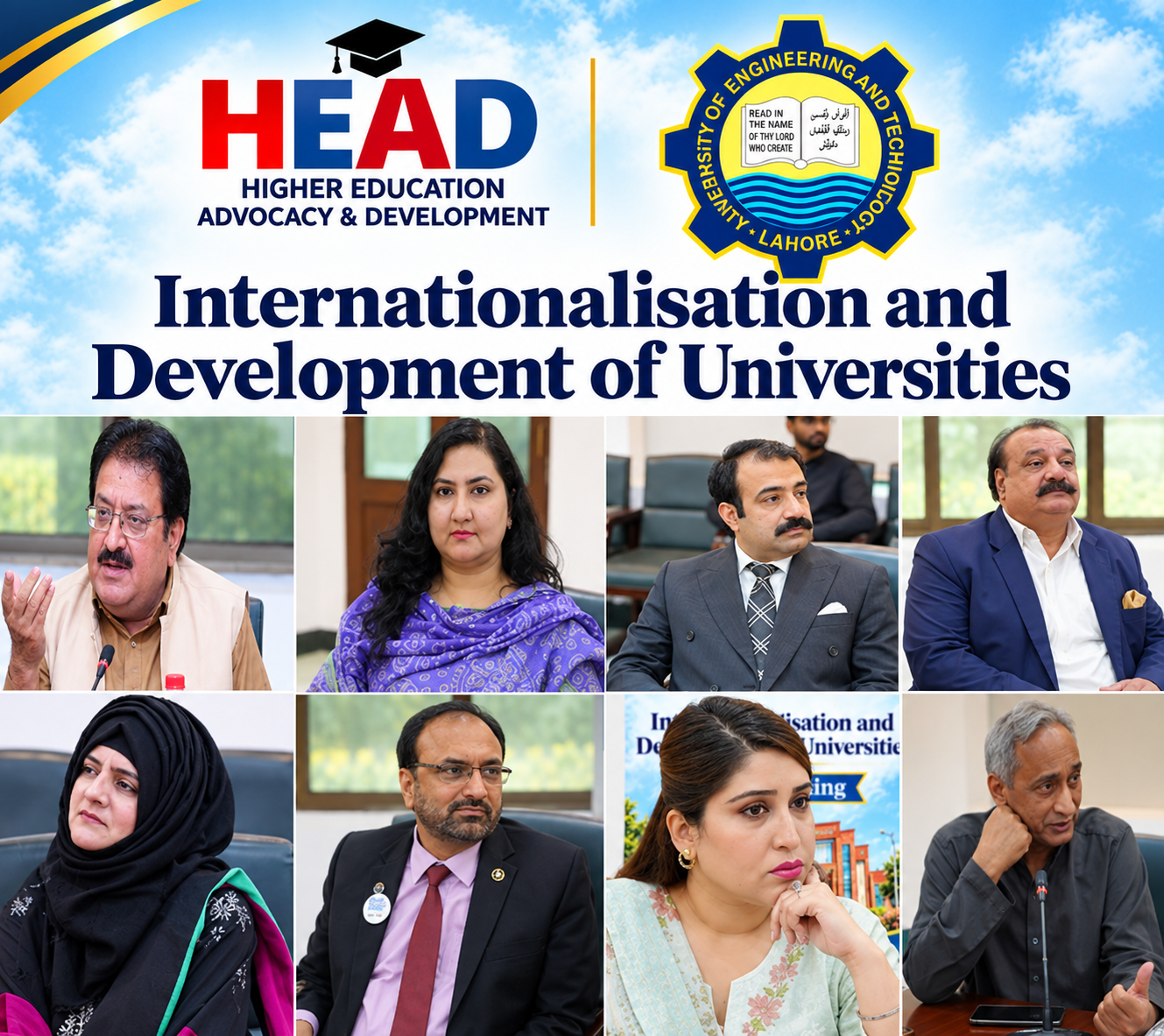
LAHORE (Press Release) : Higher Education Advocacy and Development (HEAD) Chairman Naeem Masood has said that quality education in Pakistani universities cannot be ensured without faculty and student exchanges under internationalisation programmes and stronger international consortium development.
He was speaking at a joint seminar titled “Internationalisation and University Development”, organised by HEAD in collaboration with the University of Engineering and Technology (UET), Lahore. The seminar was chaired by UET Vice Chancellor Engineer Dr Shahid Munir, while former federal minister and former senator Syed Javed Ali Shah attended as the chief guest. Secretary Revenue, Punjab Revenue Board, Shafqatullah Mushtaq, was also present.
Naeem Masood stressed the need to allow internationally recognised Pakistani researchers to establish spin-offs so that university professors could move towards patents and high-quality innovation.
He said universities across Pakistan should benefit from the Higher Education Commission’s three Transnational Education (TNE) policy models.
Under TNE-1, an international university can establish a branch in Pakistan. TNE-2 allows a foreign university to offer a franchise arrangement with a Pakistani university, including an opportunity for students to physically attend semesters at both institutions. Under TNE-3, universities in both countries can jointly offer a double-degree programme.
Speaking on the occasion, UET Lahore Vice Chancellor Engineer Dr Shahid Munir said the university had already started working on spin-offs and had launched a joint project with a Chinese university. Under the project, the Chinese university will establish a laboratory, while faculty and student exchange programmes will also be introduced.
He said UET was also working on joint study and research projects with Germany. The university has initiated several projects related to soft power, education diplomacy and applied research, while also receiving support from UNESCO.
Dr Shahid Munir also shared his observations and experiences from his visits to Germany, Nepal and China with young researchers and faculty members from various institutions.
Former federal minister and former senator Syed Javed Ali Shah said that the responsibilities of Pakistani universities had increased in the era of the global village and artificial intelligence.
He said university leadership could no longer limit students and faculty to verbal commitments and must take practical steps, while the government also needed to play its role in supporting such initiatives.
Punjab Revenue Board Secretary Shafqatullah Mushtaq said internationalisation could open numerous new opportunities for Pakistan’s young generation and help raise the country’s profile internationally. He described Pakistani youth as highly talented and hardworking.
HEAD Secretary Dr Anjum Tahira and Dr Rabia Tariq also spoke at the seminar, saying internationalisation would promote research competition and strengthen the culture of research, an area on which UET had already started working.