The Strategic Political and Defence Committee of the Makkah defence alliance, which met in Riyadh on October 5, agreed to begin the practical implementation of collective defence commitments among Pakistan, Saudi Arabia and Türkiye.
The committee said the three countries would take necessary measures to provide agreed military forces and capabilities and ensure their rapid deployment in Saudi Arabia, subject to existing arrangements and the national laws of the member states.
However, the decision appears narrower than some public interpretations of the agreement. It focuses on deploying previously agreed capabilities inside Saudi Arabia rather than authorising a joint military campaign outside the Kingdom.
The move comes amid renewed attacks by Yemen’s Ansar Allah movement, commonly known as the Houthis, against southern Saudi Arabia. During September and early October, the group launched missiles and drones towards Saudi cities and energy infrastructure, with Riyadh saying that some attacks also targeted the holy cities.
One of the reported strikes hit a power station in Madinah that supplies electricity to the Prophet’s Mosque.
At the same time, Yemen’s Aden-based Presidential Leadership Council announced a counteroffensive aimed at reversing Ansar Allah’s gains along the Red Sea coast. Government forces, supported by coalition air power, claimed to have retaken Mocha and positions near the Bab al Mandeb Strait, although those claims remain disputed.
The developments in Yemen occurred around the same time as the Riyadh meeting and are politically connected, although there is no clear evidence that they formed part of a single operational plan.
Importantly, the committee’s statement did not refer to Mocha, Bab al Mandeb or military operations inside Yemen, nor did it explicitly name the Houthis.
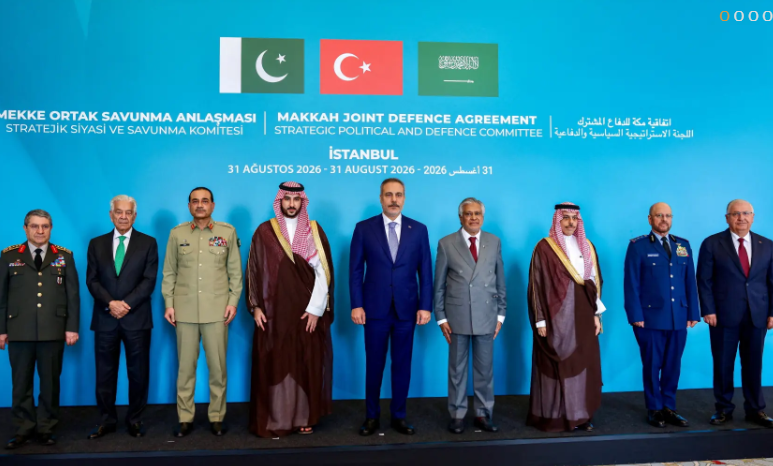
The trilateral alliance has made significant institutional progress since its establishment on August 7.
An inaugural summit was followed by a meeting of the Strategic and Political Committee in Istanbul in late August.
On September 25, the military chiefs of the three countries met in Riyadh and agreed to strengthen intelligence sharing, military coordination and capability integration. They did not announce the creation of a joint military command.
Pakistan’s Chief of Defence Forces and Army Chief Field Marshal Asim Munir also held discussions with Saudi Defence Minister Prince Khalid bin Salman on continuing joint efforts to counter attacks against the Kingdom.
The October 5 meeting marked another step in establishing the alliance’s institutional structure. The committee endorsed retired Lieutenant General Nauman Mahmood as its first secretary general and placed the Riyadh-based secretariat under his supervision.
It also authorised the rapid deployment of military forces and capabilities that had already been agreed upon.
So far, the alliance has established a political commitment, appointed an institutional head, created a secretariat, held two committee meetings and brought together the military chiefs of the three countries before moving towards implementation.
However, several elements of a fully integrated military alliance remain undefined. These include a permanently assigned force, a joint commander, publicly stated rules of engagement and a common military doctrine.
There is also no publicly announced authorisation for Pakistani or Turkish troops to take part in combat operations inside Yemen.
Turkish officials have said Ankara is providing mainly defensive and technical assistance to Saudi Arabia to help counter Houthi attacks. The support is expected to include military equipment, intelligence sharing and weapons systems, rather than the deployment of Turkish combat forces.
Several fundamental questions about the alliance remain unresolved, including what constitutes an attack or threat, which actors the alliance is intended to deter, what circumstances would trigger a collective response and who would have authority to order military action.
In the absence of a publicly available charter or military doctrine, the alliance’s operating principles must be assessed through the August agreement, subsequent government statements and the October 5 decision.
The agreement refers to an armed attack affecting a member state’s security, sovereignty or territorial integrity, with particular emphasis on protecting Makkah and Madinah.
It does not publicly define whether attacks on military forces, ships, diplomatic missions or personnel outside national territory would trigger collective action.
Although the Houthis are widely viewed as the immediate source of attacks against Saudi Arabia, the agreement does not explicitly identify the group. Iran is also widely regarded as an important source of support for the Houthis, but it is not named in the agreement either.
The alliance’s collective deterrence appears to rely on military preparedness, coordination and the ability to respond to threats. No specific retaliation strategy has been announced.
Any response appears to depend on a request from the member state under threat, agreement among the partners on the measures to be taken and compliance with each country’s domestic laws.
Pakistan’s Deputy Prime Minister and Foreign Minister Ishaq Dar has described the agreement as defensive and said it does not have an offensive agenda.
Defence Minister Khawaja Asif has said Pakistani and Turkish forces would provide supporting capabilities, including reconnaissance, while Saudi forces would remain responsible for combat operations.
The October 5 decision, which focuses on deployment inside Saudi Arabia, is broadly consistent with that interpretation.
The capabilities being discussed, including air and missile defence, reconnaissance, intelligence, counter-drone systems and technical assistance, also indicate a primarily defensive framework.
Despite the defensive position expressed by Pakistan and Türkiye, Saudi Arabia appears to have broader expectations from the alliance.
Saudi Defence Minister Prince Khalid bin Salman said after the meeting that the committee had reaffirmed solidarity in responding to attacks against the Kingdom and the holy sites and in strengthening collective deterrence against those attacks and those supporting them.
While the reference to Houthi attacks is apparent, the phrase concerning those supporting the group is broader than the language used in the joint statement.
Pakistan and Türkiye have maintained that the alliance is not directed against any particular country.
The three countries also have different strategic interests. Saudi Arabia wants stronger protection for its territory and greater pressure on actors threatening its security.
Pakistan seeks to fulfil its defence commitments to Saudi Arabia while avoiding involvement in another Yemen war or a confrontation with Iran.
Türkiye, meanwhile, is seeking a greater regional security role but must also operate within its own political and legal framework.
These differences can remain manageable as long as the alliance continues to focus on collective defence.
The agreement refers specifically to capabilities that have already been “agreed” and states that deployments inside Saudi Arabia will be carried out in accordance with national laws.
This means the pact does not amount to an automatic military response similar to the collective-defence mechanism associated with Article 5 of NATO. Consultation, agreement and domestic legal procedures would still be required before military action.
Saudi Arabia can therefore expect defensive reinforcement, political support and additional capabilities for protecting its territory. The agreement does not, at this stage, constitute an automatic commitment by Pakistan or Türkiye to conduct military operations outside Saudi Arabia.
The reference to national legislation is particularly significant for Pakistan because any broader military role could revive debate over the unanimous parliamentary resolution adopted in April 2015.
The resolution called for Pakistan to remain neutral in the Yemen conflict while stating that the country would stand alongside Saudi Arabia if its territorial integrity or the two holy mosques came under threat.
A deployment aimed at defending Saudi territory and the holy sites could therefore be presented as consistent with that position.
However, direct participation in fighting around Mocha or elsewhere in Yemen would raise more complicated political and legal questions and could require fresh political authorisation.
Türkiye faces its own constitutional restrictions. Article 92 of the Turkish Constitution requires parliamentary approval for the deployment of troops abroad, although equipment, technical personnel and specialists can potentially be provided through different mechanisms.
The trilateral framework also builds on an existing military relationship between Pakistan and Saudi Arabia rather than replacing it.
Under the 2025 Strategic Mutual Defence Agreement, Pakistani air and support personnel were already deployed in Saudi Arabia.
Pakistan’s military spokesman Lieutenant General Ahmed Sharif Chaudhry recently said Pakistani troops had been stationed in Saudi Arabia for decades and operated across multiple areas.
The understanding between Field Marshal Asim Munir and Prince Khalid to continue cooperation against attacks on Saudi Arabia has also kept the bilateral defence relationship active while bringing it closer to the broader Makkah alliance.
The additional capabilities expected under the October 5 decision are more likely to include air defence, intelligence, reconnaissance and specialist support than a large Pakistani ground deployment for operations in Yemen.
The next phase will show how far the agreement is implemented, including whether additional Pakistani air defence or air assets are deployed to Saudi Arabia and whether Turkish systems and specialists are introduced.
A wider role in fighting along Yemen’s Red Sea coast could expose differences between the formal wording of the agreement and Saudi Arabia’s broader interpretation of collective deterrence.
Another major challenge is military interoperability among the three countries.
Pakistan, Saudi Arabia and Türkiye operate different military equipment and technological systems, and there is currently no public evidence of a fully integrated air picture, joint intelligence-fusion centre or system allowing sensors from one country’s military to routinely direct weapons operated by another.
The three countries have agreed to strengthen intelligence cooperation, but information sharing does not necessarily amount to full military integration.
For now, the alliance can strengthen Saudi Arabia’s existing defensive capabilities without necessarily operating as a single unified military force.