
The United Nations has called for stronger international oversight of artificial intelligence (AI) in military operations, warning that the growing reliance on autonomous technologies could undermine human decision-making and increase the risk of unintended conflict.
During a briefing at UN headquarters, Robin Geiss, director of the UN Institute for Disarmament Research (UNIDIR), raised concerns over the increasing use of AI in warfare, questioning whether machines should be allowed to make decisions that determine human life and death.
Geiss warned that military AI systems were increasingly replacing human judgment, including in areas related to nuclear security. AI is already being used for intelligence analysis, target identification, drone operations and cyberattacks, significantly accelerating military operations.
According to the UN official, these technologies are shortening the time between identifying a target and launching an attack, while enabling military forces to engage an unprecedented number of targets in a single day.
He cautioned that the limited transparency of advanced AI systems could increase the likelihood of technical errors, miscalculations and unintended military escalation. The growing accessibility of these technologies could also enable non-state armed groups to carry out increasingly sophisticated operations.
Geiss acknowledged that geopolitical rivalries remain a major obstacle to establishing international rules for military AI. However, he noted that concerns about the technology’s potential dangers are gaining recognition across political divides.
In September, the United States proposed an AI-related notification mechanism with China to alert each other about incidents involving artificial intelligence that could threaten national security.
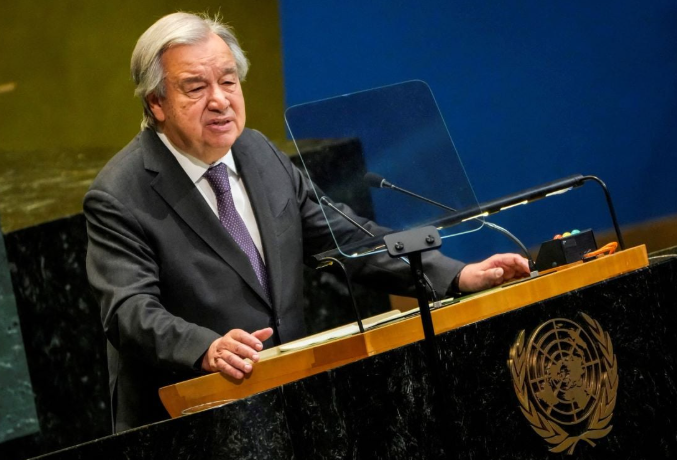
The UN has also intensified calls for stronger international regulation of military AI. Secretary-General António Guterres has advocated a legally binding treaty governing lethal autonomous weapons systems.
To advance international cooperation, UNIDIR is developing initiatives through its Centre of Excellence on AI, Peace and Security. A new forum is intended to bring together stakeholders to discuss the implications of AI for international peace, security and military operations.
The initiative will focus on developing voluntary guidelines for responsible industry practices, establishing a common terminology for concepts such as autonomy and safety, and addressing the potential use of AI by non-state armed groups in military planning, operations and logistics.
The efforts reflect growing concerns within the UN that technological advancements must be accompanied by effective safeguards to prevent serious humanitarian and security consequences.
Separately, Pakistan raised concerns about the combined impact of artificial intelligence, synthetic biology and advances in life and chemical sciences during a thematic debate on other weapons of mass destruction at the UN General Assembly’s First Committee.
Addressing the committee, Counsellor Syed Atif Raza warned that scientific advancements were progressing faster than the development of international governance frameworks.
He emphasised that emerging technologies were creating new risks that require stronger international cooperation, effective oversight and appropriate safeguards.
Pakistan’s intervention underscored the need for global efforts to address the security implications of rapidly advancing technologies and prevent their potential misuse.