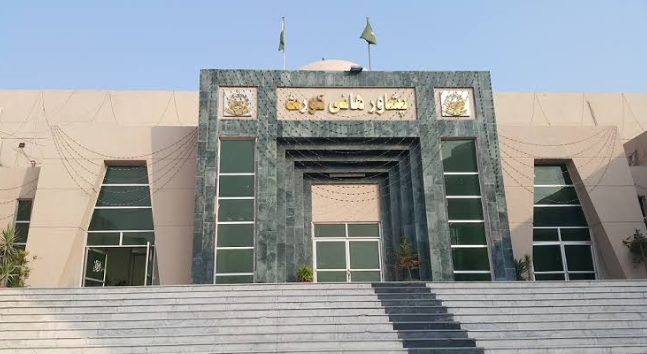
The Peshawar High Court (PHC) has set aside the nominations for the vice chancellor of Khyber Medical University (KMU) and sent the matter back to the Academic Search Committee for reconsideration.
A bench comprising Justice Syed Arshad Ali and Justice Dr Khursheed Iqbal issued the directions while hearing a petition filed jointly by senior professors and shortlisted candidates Dr A.H. Amir and Dr Mohammad Ayaz Khan.
The petitioners had challenged the selection process, alleging that the authorities had failed to comply with mandatory statutory requirements and prescribed merit criteria for the appointment.
The court had last month restrained the Khyber Pakhtunkhwa government from issuing a notification for the appointment of the vice chancellor.
In its two-page short order, the bench partially allowed the petition, with detailed reasons to be issued later.
The court directed the Academic Search Committee to reconsider the panel of eligible candidates after obtaining opinions from the KP Law Department and the Pakistan Medical and Dental Council on the applicability of the 2025 regulations governing appointments to senior positions in medical institutions.
Under the regulations notified on Feb 27, 2025, a candidate for appointment as vice chancellor of a medical university must have served as a professor for at least 10 years in a recognised medical institution.
The court directed that if the Law Department and PMDC give conflicting opinions, the issue should be resolved under the Rules of Business, 1985, or referred to the provincial cabinet for an appropriate decision.
After receiving the relevant opinion or decision, the Academic Search Committee will submit fresh recommendations for the appointment of the KMU vice chancellor to the competent authority.
The petitioners had argued that the candidates were evaluated primarily through interviews, while objective criteria prescribed under Schedule II of the Universities Act were allegedly disregarded.
Senior counsel Amir Javed, representing the petitioners, contended that the selection process had been conducted in violation of the Universities Act, 2012.
He said the prescribed merit formula allocated 70pc weightage to objective criteria, including academic qualifications, research publications, administrative experience, leadership credentials and professional achievements, while the interview carried only 30pc weightage.
According to the counsel, an interview could not override the substantial weight assigned to academic and professional qualifications.
He also questioned the eligibility of the candidates reportedly recommended by the search committee, claiming that some had less than two years of relevant experience as professors and therefore did not meet the alleged mandatory 10-year requirement.
Mr Javed argued that the authorities could not disregard a statutory eligibility requirement by invoking discretionary powers and maintained that such powers had to be exercised objectively, on merit and in accordance with the law.
During the proceedings, the provincial government’s law officer and counsel for the respondents maintained that determining eligibility criteria and the appointment process fell within the provincial government’s exclusive domain.
The petitioners’ counsel rejected the argument, referring to Supreme Court judgments and maintaining that discretionary powers could not be exercised arbitrarily or without legal limits.
He argued that the provincial government could not use its discretionary authority to bypass mandatory eligibility requirements or alter prescribed criteria without following the procedure laid down by law.