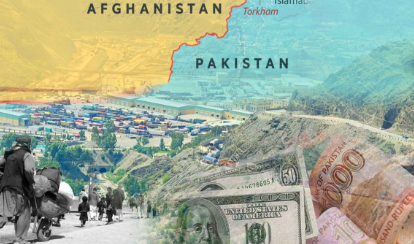
The sharp decline in Afghanistan’s transit trade through Pakistan is emerging as one of the clearest signs of Kabul’s efforts to diversify its trade routes, with Iran and Central Asia increasingly replacing Pakistan as key corridors.
Container traffic through Pakistan had risen to nearly 89,000 containers worth around $5 billion before the Taliban returned to power. It reached a record 102,886 containers valued at $6.7 billion in FY23 before beginning a steep decline.
According to customs data cited in a recent Dawn report, volumes fell to 54,114 containers worth $1.36bn in FY24 and 42,959 containers in FY25. In FY26, the figure dropped dramatically to just 11,592 containers valued at $367 million.
The figures indicate that Pakistan’s border restrictions introduced in October 2025 did not trigger the decline but accelerated an existing trend.
Afghanistan has increasingly diversified its trade routes, with Iran emerging as its most important alternative. The World Bank’s Afghanistan Economic Monitor said the Iranian corridor had become a major component of the country’s import supply chain.
In FY25, Iran accounted for 31.3 per cent of Afghanistan’s imports, while imports directly from Iran and those routed through Iranian territory together represented 48.6pc of total Afghan imports. Trade routes through Central Asia are also gaining significance.
The shift means Pakistan is losing more than transit revenue. Its traditional role as Afghanistan’s main gateway to international markets is also being weakened. Reverse-transit trade has suffered an even sharper decline, with Afghan exports passing through Pakistan to third countries falling from $454 million in FY25 to just $7m in FY26, according to customs data.
For decades, Afghan demand supported a broad commercial network linking Karachi’s ports with Peshawar and border markets. Manufacturers, wholesalers, transporters, clearing agents, warehouses and financial intermediaries all benefited from the movement of goods to Afghanistan.
The decline in trade is now putting pressure on businesses across the supply chain. Industries in Khyber Pakhtunkhwa already face high energy, financing and transportation costs, while weaker demand from Afghanistan is further reducing capacity utilisation.
Sectors including cement, construction materials, food products, pharmaceuticals, textiles and consumer goods have traditionally relied on the Afghan market. A decline in Afghan orders could therefore affect manufacturers and wholesalers, while reduced cross-border traffic could also hurt transporters, warehouse operators and other service providers.
Disruptions to imports of industrial inputs, including coal from Afghanistan, could further increase production costs at a time when export demand is weakening.
The simultaneous rise in input costs and decline in demand could put additional pressure on Pakistani manufacturers, limiting their ability to compete in Afghanistan as well as domestic and other international markets.
The impact is also being felt in agricultural trade, where delays at border crossings can result in significant losses because fruits and vegetables are highly perishable.
In 2025, five southern Afghan provinces, the country’s main grape-producing region, exported 44,225 tonnes of grapes worth $13.8m. Nearly 43,000 tonnes were sent to Pakistan, with the remainder exported to Bangladesh, Iraq and India.
However, exports reportedly fell sharply in 2026, with only 256 tonnes worth around $100,000 shipped so far, according to a recent Associated Press report. The losses affect not only Afghan farmers but also Pakistani transporters, commission agents, wholesalers and retailers involved in the cross-border trade.
At the centre of the dispute is the Afghanistan-Pakistan Transit Trade Agreement (APTTA), which was designed to provide Afghanistan access to Pakistani seaports while creating a potential trade corridor for Pakistan towards Central Asia.
However, security concerns, allegations of smuggling, regulatory disputes and political tensions have gradually undermined the agreement.
Pakistan has argued that transit facilities are sometimes misused, with goods intended for Afghanistan being diverted into domestic markets. Such practices can result in revenue losses for the government and create unfair competition for local businesses.
In October 2023, Pakistan introduced a 10pc processing fee on selected categories of Afghan transit goods, including garments, footwear, machinery, blankets and textiles, as part of efforts to prevent misuse of the transit system.
Afghan traders, however, have raised concerns over additional documentation, financial requirements, inspections and delays at border crossings, all of which increase the cost and uncertainty of doing business.
As alternative routes through Iran and Central Asia become more commercially viable, Afghan traders have greater incentives to shift their supply chains. Once established, these new trade networks could be difficult for Pakistan to regain.
Afghanistan is also likely to face costs from the shift, including longer routes and potentially higher transportation and logistics expenses. At the same time, Pakistan risks losing port activity, trucking business, warehousing, customs-related revenue and access to Afghan markets.
The consequences are particularly significant for Khyber Pakhtunkhwa, where Peshawar and the wider Khyber corridor have historically benefited from trade between Pakistan, Afghanistan and Central Asia.
The Pak-Afghan Joint Chamber of Commerce and Industry estimates that Pakistani exporters suffered around $225 million in losses over eight months of this year due to trade restrictions and border blockades. The chamber estimates Pakistan’s annual exports to Afghanistan at around $1.5bn, while exports to Central Asian markets through Afghanistan stand at approximately $800m annually.
With Afghanistan increasingly diversifying its trade routes, Pakistan’s geographical advantage is being eroded. Islamabad therefore faces pressure to address the issue through a predictable and rules-based transit framework rather than treating the decline solely as a security or diplomatic dispute.
A stable transit arrangement would benefit both countries by reducing trade costs, restoring business confidence and preventing further disruption to the interconnected economies on both sides of the border.