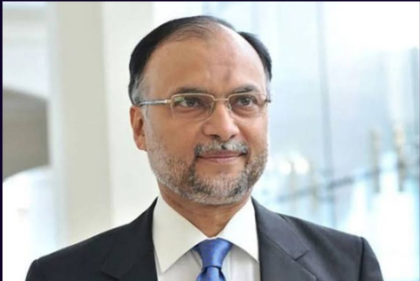
Planning Minister Ahsan Iqbal has said Pakistan’s mineral resources are estimated to be worth around $7 trillion, but attracting investment in the sector remains difficult due to high initial costs, long project timelines and political uncertainty.
Speaking with Farwa Amin, director for South Asian initiatives at the Asia Society Policy Institute in New York, Mr Iqbal said large-scale mining projects require substantial upfront investment and years before generating returns. He identified political instability as a major obstacle for international investors.
He said improved economic stability had enabled the government to actively seek foreign investment, including from US companies. Pakistan is pursuing partnerships through initiatives such as a memorandum of understanding with US Strategic Metals, possible EXIM financing and participation in international discussions on critical minerals.
On water security, Mr Iqbal criticised India’s decision to place the Indus Waters Treaty in abeyance, calling it the first modern example of water being used as a strategic weapon. He said the treaty had remained intact for nearly seven decades, including during several wars between the two countries.
The minister warned that India could potentially control the timing of water releases, withholding supplies when Pakistan needs water for agriculture and releasing it at less critical times.
To strengthen water security, Pakistan is speeding up work on new reservoirs. Mr Iqbal said the Diamer-Bhasha and Mohmand dams would collectively provide around six million acre-feet of additional storage capacity once completed.
He said the projects would help Pakistan cope with climate-related fluctuations in water availability and reduce its vulnerability to upstream water management. At the same time, Islamabad was using diplomatic channels to prevent the dispute from escalating into a wider conflict.
Mr Iqbal also said geoeconomics was becoming a key pillar of Pakistan’s foreign policy under the Uraan Pakistan framework and the government’s 5E strategy. He argued that Pakistan’s ties with the United States should move beyond their traditional focus on security and geopolitics towards trade, investment and economic cooperation.
However, he stressed that stronger engagement with Washington would not come at the expense of Pakistan’s relationship with China.
Describing Beijing as a “trusted partner”, Mr Iqbal said China had played a major role in addressing Pakistan’s energy crisis through the first phase of the China-Pakistan Economic Corridor (CPEC). He said the initiative brought around $25 billion in investment and contributed to ending prolonged power shortages while improving highways, fibre-optic networks and Gwadar Port.