
Article
Suhrawardy: Exploring Politics, Democracy, and History — Part 2
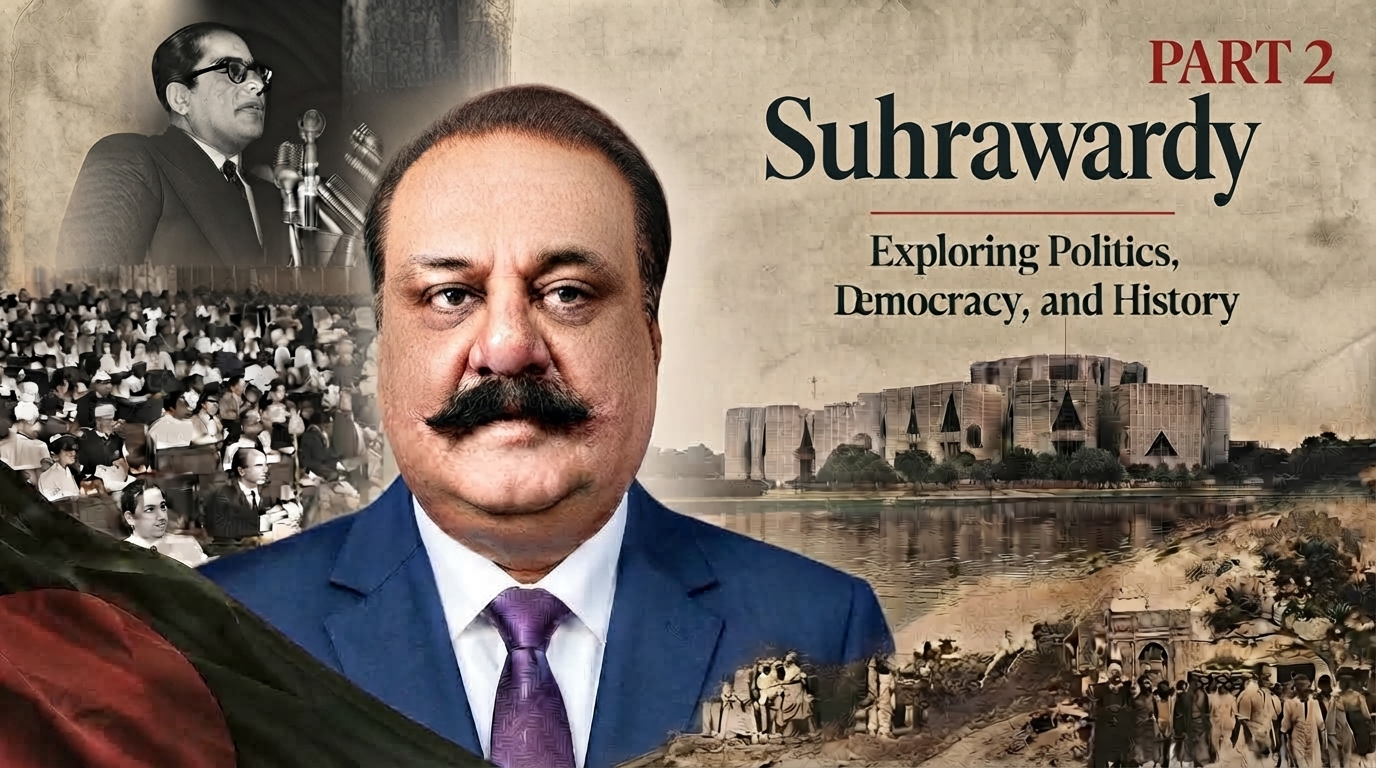
By: Naeem Masood
Who wouldn’t find it astounding that someone could revere a figure as a spiritual guide, view him as a political mentor, and feel burdened by his debt of gratitude, yet when that guide lies on a sickbed far from home, this deeply indebted individual visits his supreme leader only once, and that too for a mere fleeting moment? Not only that, but when the beloved leader is on the brink of death and returns to his residence, neither the person who gained wealth, glory, and power from the ailing friend nor any member of his cabinet visits him.
This peculiar account comes to light in Suhrawardy’s Political Memoirs (edited by Mohammad H.R. Talukdar and translated by Wajahat Masood). When Governor-General Muhammad Ali Jinnah was moved to Ziarat during his illness, Prime Minister Liaquat Ali Khan visited him only once for a brief moment. Upon returning to Karachi, no member of the cabinet personally presented themselves before the Quaid. Whether historians record this incident or not, history itself can never forget the political insight and lesson embedded within it.
It appears that in those early days, no political party or politician possessed the level of organization required to handle the country’s nascent complexities. When historians and analysts ponder this together, it seems bureaucracy was treated as the ultimate remedy from the very beginning. Around one hundred officers—trained and nurtured under British rule became the essential cadre. Consequently, these officials saddled the politicians and their patrons early on, a saddle that remains firmly in place to this day. Even now, in 2026, the administrative grip of the bureaucracy in Punjab stands at seventy to eighty percent. If one looks toward the judiciary, its share is a step ahead of the bureaucracy, not behind. As for politicians, when eighty percent lack administrative, educational, and constitutional acumen, if the bureaucracy does not saddle them, what else will it do?
Political parties certainly have lawyers equipped with educational familiarity and constitutional understanding. Yet, some of them enter power indirectly to become figures like Sharifuddin Pirzada, while others as champions of “politics and the state” blindfold the eyes of judicial wisdom, plunging it into darkness and becoming brands of institutional decay. In this lineage stand figures like Maulvi Tamizuddin, Nasim Hasan Shah, Iftikhar Muhammad Chaudhry, Saqib Nisar, and their cohorts.
Education was first entrapped by shortsighted curricula. Later, bureaucracy seized control of political appointments, a shift that solidified after the non-party assembly elections of 1985. Today, schools and colleges stand devalued, and teachers remain stripped of respect. Educated assemblies once envisioned constructing universities in every city. Yet from the inception of this endeavor around 2008 across Punjab, and subsequently nationwide, higher education was surrendered to malignancy and fiefdoms. Today, universities are numerous, but most resemble dried-up rivers. During General Pervez Musharraf’s era, the efforts of Punjab Governor (Retd.) General Khalid Maqbool and the founding Chairman of the Higher Education Commission, Dr. Atta-ur-Rahman, provided momentum. However, all was laid to waste when Chief Minister of Punjab Maryam Nawaz Sharif’s bureaucracy simultaneously recruited twenty-five Vice-Chancellors more than half of whom were not even qualified to serve as professors or department chairpersons. Should the blood of this murder of higher education be sought on the hands of the bureaucracy within the Vice-Chancellors’ Search Committee, or on the hands stretching from the Chief Secretary to the Principal Secretary? There is no need for a search, as no one even bothered to wear gloves after the crime, leaving overall maladministration utterly exposed.
Had greedy politicians and their craftspeople in the civil service maintained statecraft rather than laying bare their misrule in Pakistan’s early days, conditions today would not be so dire. Another grave loss was that influential figures devoted to peace, education, and democracy were so completely erased from the syllabus that seekers of knowledge were left deprived. Neither could a document like the Hamoodur Rahman Commission Report find expression, nor could pro-democracy voices; instead, a club of dictatorship-lovers was formed, followed by an elite, and now a mafia. To sterilize a nation, first corrupt its knowledge, then its culture, and finally pass its vote through a counterfeit mold. Has the destruction of structures ever added brilliance to actions?
The first Secretary-General, Chaudhry Muhammad Ali, and East Bengal’s first Chief Secretary, Aziz Ahmed, were among the early ‘kings’ who became masters, after which the bureaucratic reign surged ahead. As Suhrawardy’s Political Memoirs notes: “Within the bureaucracy, Ghulam Muhammad, Sir Zafarullah Khan, and Nawab Mushtaq Ahmad Gurmani were rewarded with cabinet ministries around the Punjab Group. Later, top positions were handed to Ghulam Muhammad, Chaudhry Muhammad Ali, and Defense Secretary Iskander Mirza. These were the actual players in the political brawls and power struggles.”
The thought naturally arises: when no officer from Bengal was made a politician or assigned a ministerial portfolio, people everywhere must have reflected on it, and Bengali officers and citizens surely pondered it deeply. This was the first brick upon which subsequent structures were built. Discerning observers should note that Zulfikar Ali Bhutto came much later, though a certain segment attributes a vast share of “credit” to him.
In March 1948, when an uproar arose regarding whether Urdu, Bengali, or—according to some English should be the national language, one demand was that Bengali be the official language in East Pakistan and Urdu in West Pakistan, with Bengali included among the national languages. Quaid-e-Azam Muhammad Ali Jinnah did not agree, despite a prior agreement reached on March 15, 1948, between Khawaja Nazimuddin (then Chief Minister of East Bengal) and the students. Quaid-e-Azam set aside that agreement and attempted to persuade the students that just as India declared Hindi its national language, Urdu should be declared the sole national language of Pakistan, as it was acceptable to all. For the first time in history, during the annual convocation at Dhaka University in March 1948, Quaid-e-Azam Muhammad Ali Jinnah faced hostile slogans and protests from a Muslim gathering.
What historians said and wrote in the past belongs to a bygone era. However, a student of history in the present era must employ unbiased investigation and research so that future decisions can be evaluated and contemplated through these lenses. No mature nation forgets its history, for history serves as a guide to the future just as statesmen advise that a son should keep his father’s good deeds in view and continue them, while refraining from repeating his weaknesses and flaws.
(To be continued)