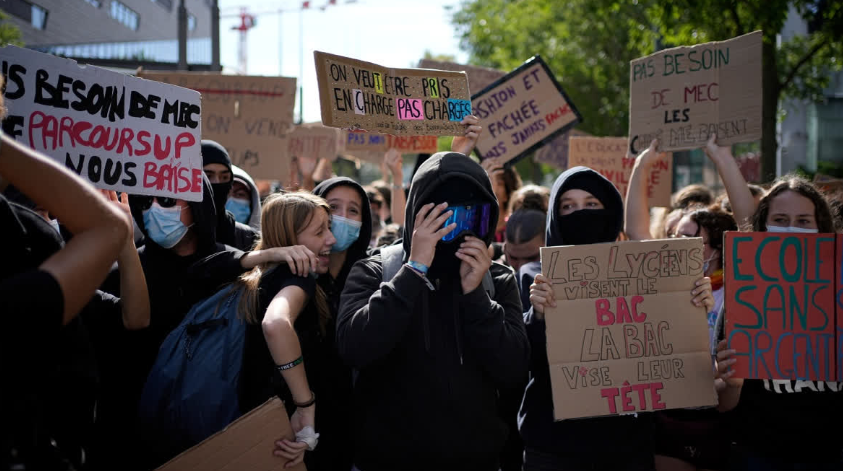
Students across France have stepped up protests over conditions in the country’s high schools, with tens of thousands expected to take part in demonstrations in Paris.
Since late September, students aged 15 to 17 have blocked entrances to hundreds of high schools, protesting teacher shortages, overcrowded timetables, deteriorating classrooms and school buildings struggling to cope with rising temperatures.
While many demonstrations have remained peaceful, some protests have involved burning rubbish bins, damaging bus shelters and clashes with riot police. Authorities have responded with batons, tear gas and riot-control rounds.
The government said 215 students and 715 police officers have been injured since the protests began. A 15-year-old student reportedly lost a hand on Monday after picking up a sting-ball grenade fired by riot police, according to a police union source.
The unrest comes just months ahead of France’s 2027 presidential election, which will determine the successor to President Emmanuel Macron, who is constitutionally limited to two terms.
Further demonstrations are expected across the country, following disruptions at 589 of France’s approximately 3,700 high schools and 32 universities, according to the education ministry and a student union.
Authorities estimate that between 20,000 and 40,000 protesters could gather in Paris.
Prime Minister Sebastien Lecornu’s office has urged demonstrators to remain peaceful and called for a return to a “structured, legal and democratic” form of opposition.
CGT labour union chief Sophie Binet said union members would be present to help protect high school students. Several trade unions and rights organisations have accused police of using excessive force against protesters.
Amnesty International also called on French authorities to halt what it described as disproportionate police repression during the demonstrations. The organisation raised concerns over the use of tear gas, batons and other crowd-control tactics.
Interior Minister Laurent Nunez said police had opened 10 internal investigations into allegations of brutality since the protests began.
The government has pledged to address students’ concerns, including teacher shortages and the poor condition of school buildings, while accusing the hard-left France Unbowed (LFI) party of helping drive the protest movement.
Veteran LFI leader Jean-Luc Melenchon has backed the demonstrations while urging protesters to remain non-violent.
According to the education ministry, 24 schools have been burned or vandalised since the movement began. More than 5,000 people have been arrested, with minors accounting for about 87 per cent of those detained. The prime minister’s office said 85 teaching staff have also been injured.
The government is also proposing legislation that would require those responsible for damaging public property to cover repair costs rather than leaving the burden on taxpayers.
Lecornu said compensation could potentially be recovered from family allowances and housing benefits, while maintaining a minimum level of income.
However, union leader Sophie Binet criticised the proposal, warning that it could disproportionately affect vulnerable families.