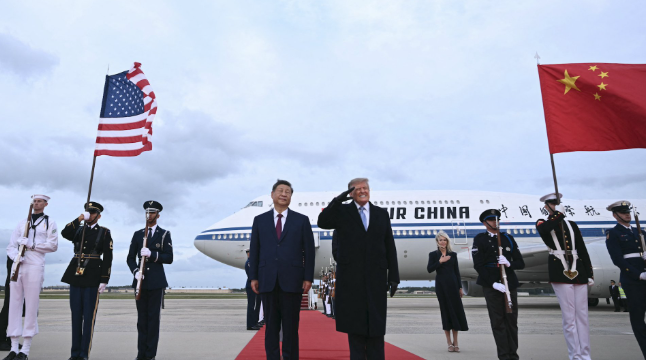
US President Donald Trump and Chinese President Xi Jinping concluded a high-profile summit on Friday, agreeing to extend their existing trade truce and hold two more meetings before the end of the year.
Despite the cordial tone of the summit, analysts said Washington and Beijing remain engaged in a broader strategic competition over trade, technology, Taiwan, defence, rare earths and industrial policy.
Daniel Russel of the Asia Society Policy Institute said that while the two leaders were seeking to maintain a cooperative relationship, the underlying rivalry between the two countries remained unresolved.
Daniel Kritenbrink, a former US official who now works with The Asia Group consultancy, said both leaders appeared interested in maintaining stability in bilateral relations at least through the end of the year. However, he said a longer-term extension of the trade truce would depend on further concrete results.
Kritenbrink also noted that some US officials remain frustrated over what they view as China’s failure to fully implement commitments made during previous negotiations.
Trump and Xi had previously agreed to a trade truce during a meeting in South Korea last year, following a period of escalating tariffs in which duties on goods between the two countries rose above 100 per cent at one stage.
Under that agreement, China committed to increasing purchases of US agricultural products, including soybeans, and suspending restrictions on rare earth exports for one year.
The agreement had been scheduled to expire in November. However, both sides agreed this week to extend it until January 10, according to US Treasury Secretary Scott Bessent.
US Trade Representative Jamieson Greer told CNBC that Washington considers such extensions to be periods for assessing compliance with the agreement.
Kritenbrink said US officials believe China is doing enough to keep the agreement in place but not substantially more, warning that such an arrangement could prove difficult to sustain over the long term.
Mary Lovely of the Peterson Institute for International Economics said the shorter extension appeared to reflect Washington’s preference for maintaining greater leverage over Beijing.
She also pointed to US concerns over the supply of rare earth magnets, suggesting Washington wants the agreement to remain under close review.
Lovely said it was increasingly unclear how effective the threat of higher tariffs remained in influencing China’s policies.
Greer said the two countries had made progress on several economic issues and were expected to release additional details on Monday.
He said Washington and Beijing were discussing a group of products that could receive preferential treatment in bilateral trade. The two sides have also agreed on certain products that could be excluded from future trade disputes.
Greer is due to host G20 trade ministers in Wisconsin next week, where US tariff threats and concerns over industrial overcapacity in China are expected to feature prominently in discussions.
The United States and China have also agreed to establish a notification mechanism for potential artificial intelligence-related threats, Bessent said.
Peter Richardson of Counterpoint Research said the mechanism could potentially take the form of a hotline, although determining which incidents should trigger communication could prove difficult.
He noted that it can be challenging to quickly establish whether an AI-related incident was directed by a government, caused by an independent actor or resulted from an accident.
Richardson said the arrangement was unlikely to produce a comprehensive international framework for AI regulation but could represent an initial practical safeguard between the two countries.
Kritenbrink said the summit had not changed the competitive approach of either country toward artificial intelligence and did not expect Washington or Beijing to slow their AI development efforts.