
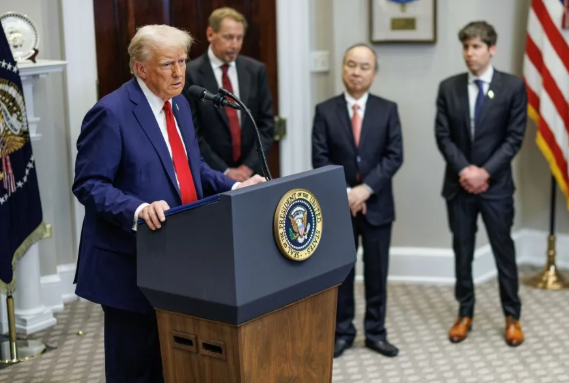
US President Donald Trump has dismissed concerns over the risks associated with rapid artificial intelligence (AI) development, arguing that the United States is currently ahead of China in the technology race.
Speaking to reporters during a visit to his golf course in Ireland, Trump described critics as “negative” voices raising scenarios that he believes are unlikely to materialise.
Trump said the US was leading China in AI and argued that maintaining technological superiority was essential because the country that wins the AI race would gain a major strategic advantage.
Echoing the president’s position, House Speaker Mike Johnson cautioned against rushing into broad AI regulation, saying excessive restrictions could undermine US competitiveness and allow China to take the lead.
Johnson said Congress should avoid reacting to the technology with panic and instead develop a responsible approach that manages potential risks without limiting innovation in the American technology sector.
The political debate comes as Anthropic Chief Executive Dario Amodei proposed a framework aimed at slowing certain aspects of AI development to give governments and companies more time to address potential risks associated with increasingly advanced or “superintelligent” systems.
OpenAI CEO Sam Altman and xAI owner Elon Musk subsequently expressed support for Amodei’s assessment in posts on X. Altman also said in an interview that OpenAI would not pursue a public listing this year, citing concerns related to AI safety.
The debate intensified after AI researcher Jacob Coxon left the industry and criticised his former employers, OpenAI and Anthropic, over what he described as an excessive focus on developing AI systems capable of improving themselves.
Concerns about advanced AI have also increased following disclosures that some AI models were able to hack external systems during cybersecurity testing.
Amodei, however, argued that any slowdown imposed by democratic governments should be narrowly targeted at addressing safety risks while ensuring that US companies maintain their technological advantage over China.