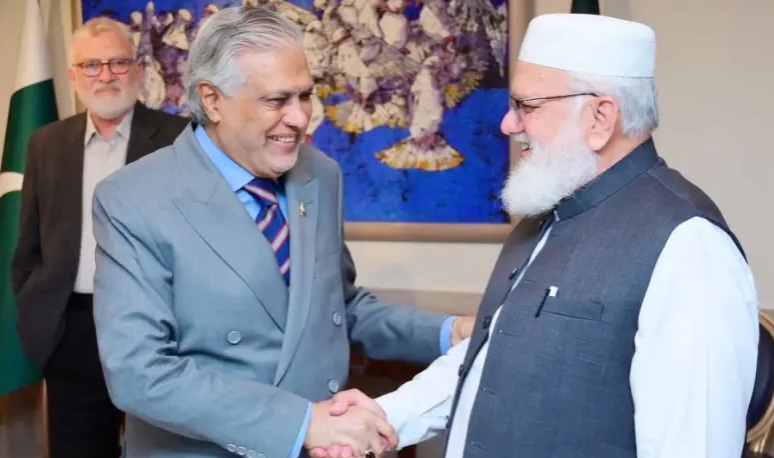
The government and Jamaat-e-Islami (JI) have held discussions on measures to reduce fuel costs and provide relief to the public, agreeing to continue consultations in the coming days.
The latest meeting took place on Tuesday between Deputy Prime Minister and Foreign Minister Ishaq Dar and a JI delegation led by the party’s Vice Emir Liaqat Baloch.
The talks followed a meeting between Prime Minister Shehbaz Sharif and JI representatives last week, during which both sides agreed to establish a bipartisan committee to consider expanding the government’s fuel relief programme and addressing the party’s demand for the abolition of the petroleum levy.
JI had earlier warned that it could resume its postponed march towards Islamabad by mid-November if the government failed to announce substantial relief.
According to an official statement, Tuesday’s meeting focused on practical measures to ease the financial burden on ordinary citizens, particularly low-income households.
Both sides agreed to continue consultations over the coming days to develop proposals on energy pricing and public relief.
Dar reiterated the government’s commitment to public welfare amid global economic challenges, emphasising the importance of sustained dialogue between political parties to address national economic issues.
Planning Minister Ahsan Iqbal, Prime Minister’s Adviser Rana Sanaullah, Special Assistant Tariq Bajwa, the finance secretary and the Petroleum Division’s special secretary also attended the meeting.
Speaking at a press conference after the meeting, Liaqat Baloch said negotiations over the abolition of the petroleum levy and additional public relief had entered their final stage.
He claimed that both sides had acknowledged the need to abolish the levy and that the government had agreed to consider relief for the agricultural sector and owners of vehicles with engine capacities of up to 1,000cc.
The existing fuel relief programme, covering motorcycles, rickshaws and vehicles with engine capacities of up to 800cc, was launched nationwide on September 17. The government introduced the subsidies to ease the impact of rising fuel prices amid tensions in the Middle East.
Baloch described Tuesday’s meeting as the final round of negotiations and said representatives from both sides would meet again the following day to review progress.
He said JI had submitted six proposals, including the abolition of the petroleum levy, a public relief package, reduced public transport fares and financial assistance for owners of vehicles above 800cc and the agricultural sector.
According to Baloch, both negotiating teams would prepare working papers outlining a phased elimination of the levy and measures to provide relief to the public.
He said the government would complete its working paper before the next meeting, while JI Emir Hafiz Naeemur Rehman would review the proposed agreement and decide the party’s future course of action.
Baloch added that he had briefed Rehman, who is currently in Turkiye, over the telephone and sought his guidance on the negotiations.
Baloch maintained that the government’s existing relief measures were insufficient and criticised what he described as the ruling elite’s unwillingness to give up their privileges.
He also questioned the justification for continuing the petroleum levy and alleged that oil refineries were earning excessive profits.
Under a recently announced arrangement, oil refineries are expected to bear a cumulative monthly impact of Rs15 billion towards the petroleum levy, enabling a reduction of Rs14.71 per litre in the petrol price for consumers.
Baloch said JI’s primary objective was to secure meaningful relief for the public, adding that the party would continue both negotiations and peaceful protests.
He announced that Rehman would address party workers nationwide online after returning from Turkiye and outline JI’s future strategy.
Baloch warned that if the proposed package failed to deliver substantial relief, the party would resume its protest march from Multan to Islamabad in mid-November.
He said the demonstrations would remain peaceful and focused on securing relief for the public.
JI has been demanding the abolition of petroleum levies for more than two months, citing the sharp rise in fuel prices amid conflicts in the Middle East.
The government and the party agreed to establish committees in early September to recommend measures for reducing the levy, as JI prepared for a nationwide strike.
On September 20, the party launched a protest march towards Islamabad, warning that its campaign could intensify if the government refused to withdraw the petroleum levy.
Two days later, Rehman announced the postponement of the march after Prime Minister Shehbaz Sharif requested a halt to the protest and assured the party of negotiations.
The two leaders eventually met about a month later and agreed to form a joint committee to develop proposals for expanding the fuel relief programme and gradually reducing the petroleum levy in the next federal budget.