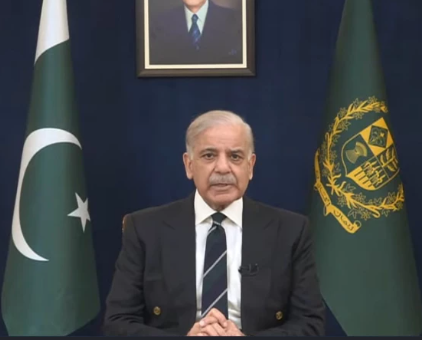
Prime Minister Shehbaz Sharif has announced a new package of austerity and fuel conservation measures as rising international petroleum prices add pressure to Pakistan’s economy amid the escalating Gulf conflict.
The decisions were taken at a high-level meeting chaired by the prime minister to review measures aimed at conserving energy and reducing government expenditure, according to a statement issued by the Prime Minister’s Office.
The prime minister said the increase in international petroleum prices was creating inflationary pressures globally and stressed that the government and the elite should make sacrifices first.
He said the government had already introduced a fuel subsidy for economically vulnerable and middle-income groups, providing a subsidy of Rs100 per litre for motorcycles, rickshaws and vehicles with engine capacities of up to 800cc.
Sharif directed authorities to ensure the immediate and effective implementation of measures aimed at curbing unnecessary government expenditure and ensuring the prudent use of national resources.
Under the new package, fuel allocations for official vehicles have been reduced, government purchases of vehicles have been restricted, foreign travel by officials has been curtailed and official dinners have been prohibited, with the measures aimed at conserving energy amid higher fuel prices.
The austerity package, being implemented for the second time this year, also includes a ban on government purchases of durable goods, except information technology equipment, and encourages official meetings to be conducted through teleconferencing.
The government had introduced similar measures in March, including a two-week closure of schools, reductions in fuel consumption by government departments and greater reliance on remote work to reduce fuel consumption and public expenditure.
A new subsidy policy, effective from Wednesday, provides motorcycle, rickshaw and small-car owners with Rs100 per litre on a capped monthly quota to help offset the impact of higher fuel prices.
The government has, however, retained the option of relaxing the measures on a case-by-case basis if circumstances arising from the escalating Middle East conflict affect energy supplies.
The measures apply to the federal government, while the provincial governments and the administrations of Azad Jammu and Kashmir and Gilgit-Baltistan will take their own decisions.
The Cabinet Division has notified 11 austerity measures with immediate effect but has retained existing office timings, working hours and the number of working days.
Fuel allocations for official vehicles have been cut by 50% for three months. The reduction does not apply to operational vehicles used by the armed forces, civil armed forces, law-enforcement agencies, essential services and the Federal Board of Revenue.
The fuel reduction also does not apply to development projects.
The government has further ordered a 5% reduction in non-employee-related expenditure under the 2026-27 budget, with the cut to be implemented monthly. The measure will also apply to foreign missions and officers and officials posted abroad.
However, expenses related to rent, education fees and medical care will remain unaffected. Development projects are also exempt from the 5% reduction.
The government has allowed exemptions from any of the 11 measures on a case-by-case basis. Requests will be considered by the Committee for Monitoring and Implementation of Fuel Conservation and Additional Austerity Measures.
The committee will submit its recommendations to the prime minister for approval. Exemptions approved under the mechanism will not require separate approval from the Austerity Committee constituted by the Finance Division.
This is the second time since the outbreak of the Middle East conflict that the government has introduced austerity and fuel conservation measures. The government has not disclosed the savings generated by the earlier initiative.
Finance Minister Muhammad Aurangzeb said on Thursday that the central bank and Finance Ministry were assessing the potential second- and third-round effects of the conflict on Pakistan’s economy.
The government has announced compensation of Rs100 per litre for motorcycles consuming up to 20 litres per month and small cars using up to 30 litres. However, petroleum dealers have declined to participate in the scheme, saying they were not consulted before its implementation.
The government has also retained existing taxes on petrol and diesel despite the increase in fuel prices.
The notification imposes a complete ban on the purchase of government vehicles, while development projects are exempted.
A similar ban applies to the purchase of durable goods, with information technology equipment exempted. Development projects are again excluded from the restriction.
Foreign visits and official travel have also been prohibited for three months, including obligatory visits, with exceptions for scholarships offered by international development partners, training and courses arranged through the Economic Affairs Division, and programmes conducted under institutional agreements with the government.
Prime Minister Shehbaz Sharif was scheduled to travel to the United Kingdom and United States on Thursday for a 10-day visit, while Finance Minister Muhammad Aurangzeb was already in the UK.
Under the notification, Pakistan’s ambassador or high commissioner will represent the country at obligatory and important events.
An exemption has also been included for unavoidable foreign visits. In such cases, ministers, advisers, ministers of state, special assistants to the prime minister, parliamentary officials and other government functionaries will be required to travel in economy class.
During the previous austerity drive, ministers and senior officials continued to undertake foreign visits, while those travelling in business class were required to pay the fare difference themselves.
Government meetings will preferably be conducted through teleconferencing, except for intra-city meetings.
Official dinners will also be prohibited, with an exception for visiting foreign delegations.
Government-funded seminars, training programmes and conferences have been prohibited. Where such events are considered unavoidable, government facilities such as auditoriums and committee rooms will be used.
The government has also directed that only a single dish be served at marriage-related functions and events.
The government has retained the existing market-closing schedule.
Shops, markets, shopping malls, bazaars, departmental stores, grocery stores, general stores and kiryana shops will close by 9pm.
Marriage halls, marquees and other commercial venues hosting festive events will close by 10pm.
Restaurants, cafes, eateries, food outlets and standalone fruit and vegetable shops will close by 11pm.
Pharmacies, medical and medical-supply stores, laboratories, clinics and hospitals are exempt from the timings. Standalone bakeries, tandoors, milk and dairy shops, fuel stations, CNG stations and electric-vehicle charging stations will also remain exempt.
Gyms, sports facilities, sports and padel courts, information technology companies and call centres will also be allowed to operate without time restrictions.