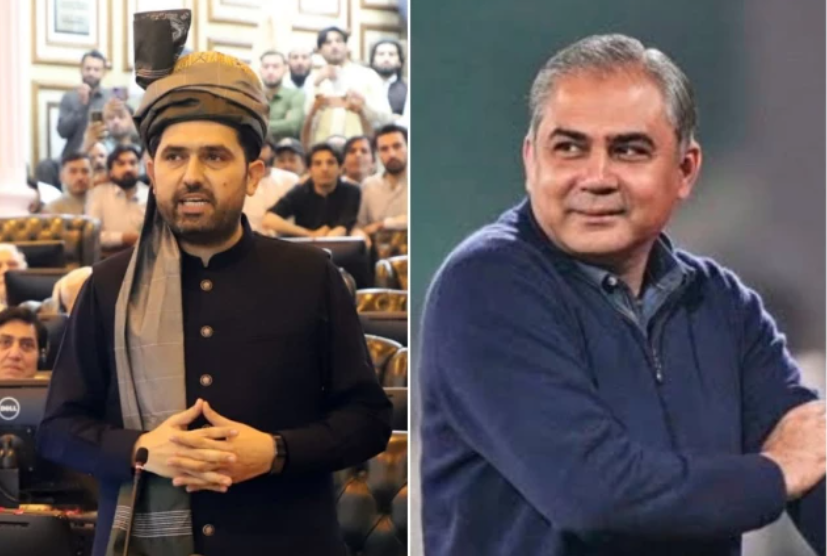
Interior Minister Mohsin Naqvi said on Sunday that talks between the federal government and the opposition had ended without a breakthrough, following an hours-long second round of negotiations focused on the Pakistan Tehreek-e-Insaf’s (PTI) planned long march to Islamabad and security issues in Khyber Pakhtunkhwa.
Addressing a press conference in Islamabad, Naqvi warned that no one would be allowed to violate an Islamabad High Court order concerning protests in the capital and said legal action would be taken against those who breached it.
The court had ruled that political parties and their leadership did not have the lawful right to occupy public roads, highways, interchanges, toll plazas or government buildings in Islamabad.
Naqvi also rejected the impression that the federal government had asked PTI to postpone its planned march, saying there had been no such request from the government.
He said the government had made it clear during the first round of talks that the march itself was not the main issue. He added that PPP Chairman Bilawal Bhutto Zardari had previously called for the protest to be postponed in order to reduce political tensions.
According to Naqvi, the negotiations involved two proposed agreements a broader political agreement covering issues discussed with opposition parties and a separate agreement concerning counterterrorism measures in KP
Naqvi said he had asked KP Chief Minister Sohail Afridi to join the negotiations because, according to him, several security-related issues involved the provincial government.
He said Afridi initially agreed to participate and the talks were postponed to allow him to engage with the opposition delegation.
Naqvi claimed the opposition delegation subsequently held discussions with the KP chief minister for around four hours, after which Afridi authorised the delegation to proceed with any matters agreed upon during those discussions.
The interior minister later alleged that the KP government withdrew from several commitments during the final stage of negotiations.
He said the proposed counterterrorism agreement included commitments relating to the review of the Police Act 2026, preventing militant groups from establishing safe havens in KP, condemning the banned Tehreek-i-Taliban Pakistan (TTP) and other militant organisations, and supporting the federal policy on Afghan refugees.
The proposed commitments also included avoiding contact with Afghanistan’s interim government, increasing funding for counterterrorism operations and police, strengthening cooperation between provincial authorities and the armed forces, addressing security issues in former Fata and the merged districts, and implementing the National Action Plan.
Naqvi said security matters should not be politicised while KP continued to face a serious security challenge.
The negotiations between the federal government and opposition representatives began at Parliament House on Saturday afternoon and continued into the early hours of Sunday.
Senate Opposition Leader Allama Raja Nasir Abbas said the talks had failed to produce a breakthrough. He identified the main areas of disagreement as jailed PTI founder Imran Khan’s meetings with his personal physicians and the strategy for combating terrorism in KP.
Minister of State for Interior Tallal Chaudhry, however, said the talks primarily failed because the KP government had not provided assurances regarding future cooperation in counterterrorism efforts.
He alleged that the provincial government was unwilling to implement the National Action Plan.
KP Chief Minister Sohail Afridi subsequently shared the draft proposals presented by him during the negotiations, rejecting the claim that the provincial government had refused to cooperate.
Afridi’s proposed framework called for regular meetings between the prime minister and opposition leaders to address political, constitutional, legal and democratic issues.
It also proposed the formation of a joint political negotiating committee comprising representatives of the ruling coalition, the PPP and opposition parties to resolve political differences through dialogue.
The KP government further sought assurances regarding the legal, medical and human rights of Imran Khan and his wife, Bushra Bibi, in accordance with the Constitution, law and prison rules.
The proposal called for allowing them to meet family members, lawyers and associates in accordance with applicable rules. It also sought expedited proceedings, where legally permissible, in appeals filed by prisoners against their convictions.
Afridi’s draft additionally called for the release of women political prisoners, including Yasmin Rashid and Bushra Bibi, on humanitarian grounds.
On security, the KP chief minister proposed greater coordination between the federal and provincial governments to combat terrorism, protect lives and property and establish lasting peace in the province.
The proposal called for authorised representatives of both governments to meet within 72 hours and formulate a joint strategy for peace and security.
Afridi said PTI would call off its planned long march if the federal government provided written assurances for implementing the agreed measures.
He added that if the government failed to honour the assurances or disrupted the negotiation process, PTI would retain the right to stage peaceful and lawful democratic protests in accordance with the Constitution and existing laws.