
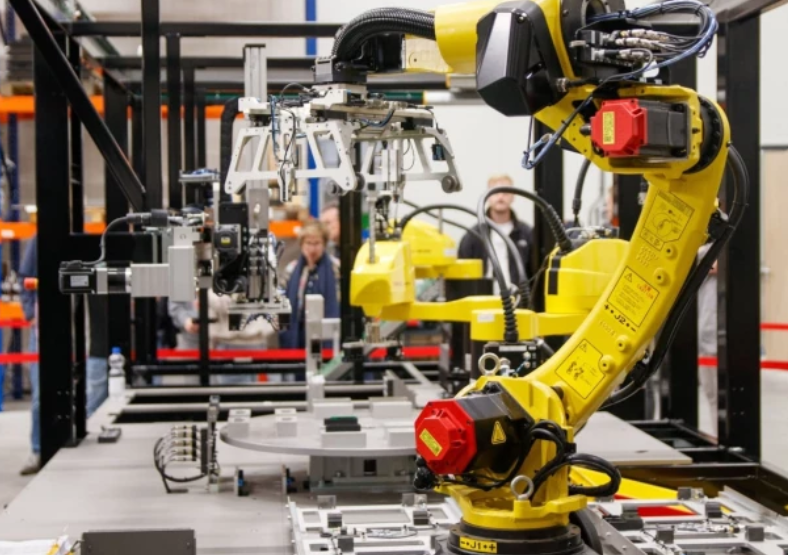
The number of industrial robots operating in factories worldwide surpassed 5 million last year, as advances in artificial intelligence (AI), supply chain changes and labour shortages continued to accelerate automation across the manufacturing sector, according to a new report.
The International Federation of Robotics (IFR) said the global stock of operational industrial robots increased by 9% year-on-year, while new robot installations rose 11% to more than 600,000 units.
China maintained its dominant position in the global industrial robotics market, with annual installations rising 20% to 354,000 units. The figure represented 59% of all industrial robots deployed worldwide during the year.
Chinese manufacturers also strengthened their position domestically, accounting for 55% of the country’s industrial robot market.
Japan recorded a 19% decline in installations to 36,219 units, dropping from second to third place. The United States moved into second place after installations increased 12% to 38,500 units.
South Korea retained fourth position with 30,200 new robot installations, followed by Germany, where installations fell 8% to 24,800 units.
India recorded significant growth, with installations increasing 15% to 10,500 units.
Germany accounted for 41% of industrial robot installations across the European Union, although its growth slowed amid declining demand in Italy, France and Spain.
Robot Demand Expected to Grow
The global demand for industrial robots is expected to continue rising in the coming years. Installations are projected to reach around 655,000 units this year and increase further to 806,000 units by 2029.
The report attributed the growing adoption of automation to persistent labour shortages in advanced economies, the relocation of supply chains closer to home markets and the development of AI-driven technologies that are making robots more affordable for small and medium-sized businesses.
Türkiye ranked 17th globally in new industrial robot installations, although annual deployments declined 9% to 3,194 units from a record 4,429 in 2023.
Despite the decline in new installations, the country’s operational robot fleet increased 7% to a record 30,990 units, placing Türkiye 15th worldwide in terms of its total industrial robot stock.
The metal industry remained Türkiye’s largest user of industrial robots, with installations increasing 8% to 990 units. The sector accounted for 31% of new installations and had 6,774 robots in operation.
The country’s automotive industry recorded a 3% increase in its robot inventory to 889 units, accounting for 28% of new installations and bringing its total active robot fleet to 11,017 units.
Automation demand weakened in several other sectors. Robot installations in electrical and electronics manufacturing, including home appliances and electrical machinery, dropped 37% to 136 units.
The food, beverage and tobacco sector saw an even sharper decline, with new robot installations falling 40% to 144 units.
The report showed that handling and machine-tending operations accounted for 59% of all newly installed industrial robots, making them the most common applications.
Welding and soldering represented another 16% of new installations.
Despite the rapid expansion of industrial automation, robot density remains relatively low in Türkiye, at 52 robots per 10,000 manufacturing workers.
The automotive sector recorded a considerably higher density of 374 robots per 10,000 workers, compared with 35 robots per 10,000 workers across other industries.