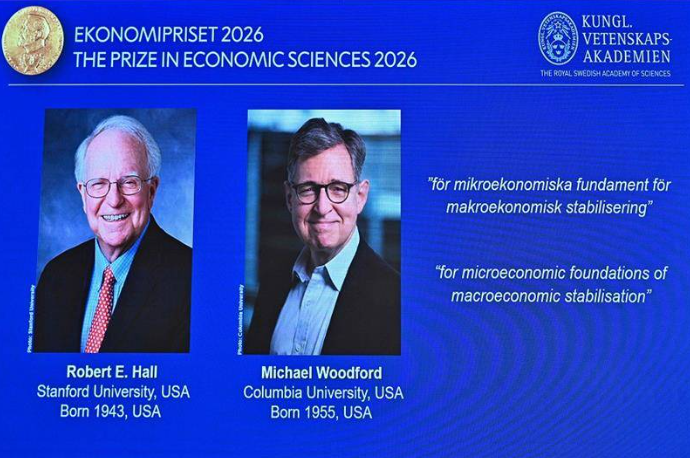
American economists Robert Hall and Michael Woodford have been awarded the Nobel Prize in Economic Sciences for developing models that help governments and central banks manage recessions and economic crises that cannot be effectively addressed through conventional policy measures.
The Nobel jury said their research demonstrated how appropriately timed fiscal and monetary policies could help moderate economic fluctuations and reduce periods of excessive growth and contraction.
According to the Royal Swedish Academy of Sciences, economic stabilisation policies have been influenced by the theories of British economist John Maynard Keynes for nearly a century. However, the oil crises of the 1970s exposed limitations in the Keynesian models used to determine when and how governments should intervene.
Hall, 83, a professor at Stanford University, and Woodford, born in 1955 and a professor at Columbia University, independently developed alternative approaches to economic modelling.
Instead of relying primarily on statistical relationships between macroeconomic indicators such as inflation, production and consumption, the economists based their models on microeconomic principles, examining how individual households and businesses collectively shape economic activity.
Their work highlights the importance of understanding how households and businesses make decisions, particularly the tendency of consumers to consider future economic conditions when deciding whether to spend or save.
The research also demonstrates how communication by governments and central banks can influence public expectations and, consequently, economic decisions.
John Hassler, chair of the Committee for the Prize in Economic Sciences, said the laureates had established a strong theoretical foundation for economic models currently used by governments and central banks around the world.
Reacting to the announcement, Woodford said he was surprised and delighted by the honour. He added that his research was not driven by a particular political agenda but aimed to strengthen the foundations of economic policymaking and improve public understanding of economic issues.
The Nobel Prize in Economic Sciences is the only Nobel award not included in Alfred Nobel’s original will. It was established in 1968 through a donation from Sweden’s central bank and follows the selection process used for the other Nobel prizes, with the Royal Swedish Academy of Sciences responsible for selecting the laureates.
Last year, the economics prize was awarded to Joel Mokyr, Philippe Aghion and Peter Howitt for their research into how technological progress influences economic growth.
Other Nobel announcements this year included awards in peace, literature, chemistry, physics and medicine, recognising contributions across a range of fields.
Like the other Nobel awards, the economics prize includes a diploma, a gold medal and prize money of approximately $1.2 million.
The laureates are scheduled to receive their awards at formal ceremonies on December 10, marking the anniversary of Alfred Nobel’s death in 1896.