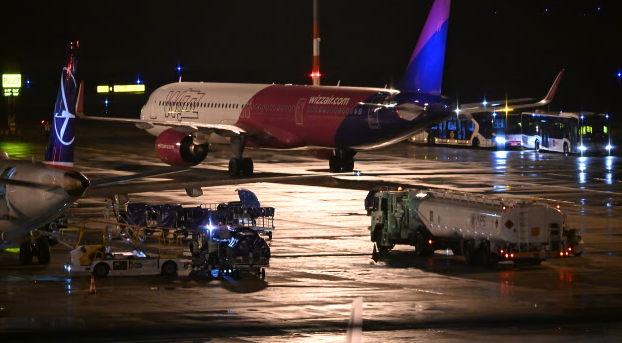
Since early September, Yemen’s Houthi movement has targeted key oil infrastructure and airports across Saudi Arabia, including Riyadh’s airport, which has reportedly come under attack 20 times.
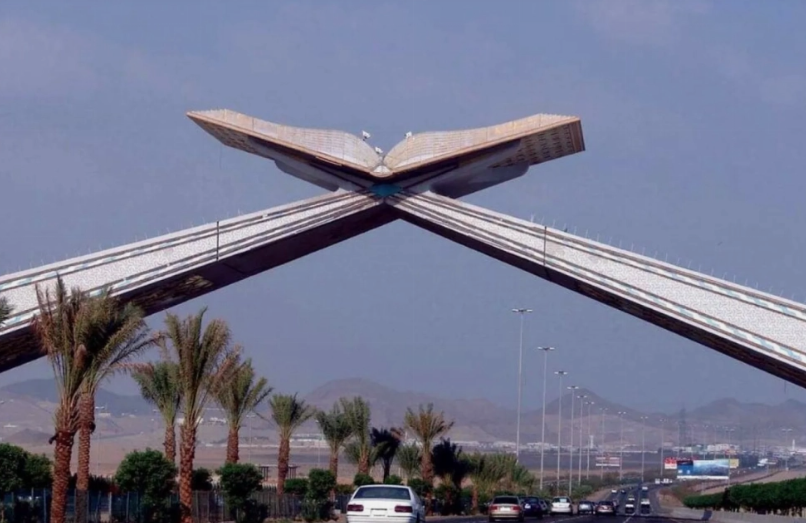
The group has also attempted, unsuccessfully, to target the holy cities of Madina and Makkah.
The renewed hostilities followed a four-year truce and were triggered by a Saudi bombardment of Sanaa airport, Yemen’s capital, in July. The strike was aimed at preventing a Houthi delegation from landing there.
Since then, the two sides have engaged in a series of retaliatory military strikes, according to April Longley Alley, a Yemen specialist at the Washington Institute think tank.
“The Houthis framed this campaign as blockade for blockade, airport for airport, escalation for escalation,” she said.
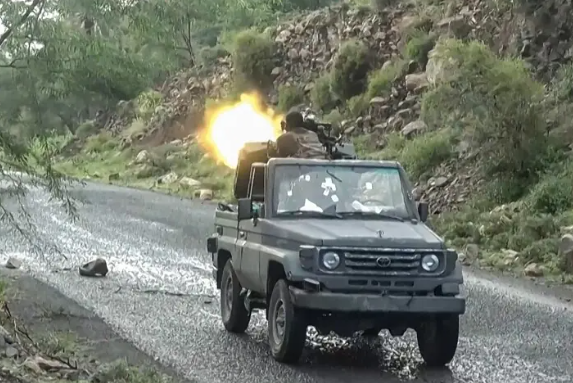
The Houthis possess an extensive arsenal of ballistic missiles and drones, which they have also used to target locations near the Bab al-Mandeb Strait, a strategic waterway at the entrance to the Red Sea.
According to Niranjan BS, a strategic weapons analyst at Jane’s, the group’s missile stockpiles partly originate from military arsenals seized when it captured Yemen’s capital, Sanaa, in 2014. Other weapons include complete systems smuggled into the country and locally assembled equipment made from components brought in through smuggling networks, primarily via the Arabian Sea.
The International Institute for Strategic Studies’ Military Balance database identifies several medium-range missiles in the Houthi arsenal, including systems derived from Iranian designs such as the Kheibar Shekan.
The group also possesses short-range missiles, including the Asef anti-ship missile, which is derived from Iran’s Khalij Fars missile family, according to the Wilson Centre think tank.
In addition, the Houthis operate cruise missiles belonging to Iran’s Quds missile family. The Quds-4 variant is believed to have a range of approximately 2,000 kilometres, according to the Wilson Centre.
Their capabilities also include aerial and maritime drones, some of which are based on Iranian designs.
Niranjan BS said the Waeid-1 and Waeid-2 aerial drones were local copies of Iran’s Shahed-131 and Shahed-136 one-way attack unmanned aerial vehicles, respectively.
Iran has provided significant military assistance to the Houthis, particularly through the supply of missiles and unmanned aerial vehicle systems, according to a report by the Middle East Institute.
The report said missile and drone components were designed and manufactured in Iran before being smuggled into Yemen through small boats, container ships or across the Oman-Yemen border, where the equipment was assembled.
In June 2024, the US Treasury imposed sanctions on a man in China suspected of having links to the Houthis. The department said he had played “a key role in procuring materials that enable Houthi forces to manufacture advanced conventional weapons inside Yemen”.
Having endured years of conflict, the Houthis are considered capable of sustaining the use of their weapons arsenal over an extended period.
April Longley Alley of the Washington Institute said the group had previously survived intensive air campaigns conducted by Saudi Arabia, the United States and Israel.
“This is a battle-hardened group, and they have much less to lose than the Saudis,” she said.
Alley added that the Houthis were likely calculating that they could sustain the confrontation for longer because they were accustomed to absorbing military strikes.