Saudi Arabia plans to establish three specialised vulture feeding stations this year as part of efforts to protect threatened bird species and reduce their exposure to poisoned and contaminated food.
The initiative follows the international publication of the Kingdom’s first national guide on establishing and managing vulture feeding sites, commonly known as “vulture restaurants.” The guide has been developed by the National Center for Wildlife (NCW) in collaboration with international conservation experts.
According to the NCW, the facilities will provide safe supplementary food for resident and migratory vultures, helping reduce deaths caused by poisoned carcasses and harmful veterinary drug residues.
The centre said local partners would assist in establishing the three stations, while other national institutions could also develop similar facilities during the year.
Dr Hany Tatwany, a conservationist with more than 36 years of experience in biodiversity protection, highlighted the importance of vultures to environmental and public health, noting that their role extends beyond wildlife conservation.
The guide, titled Vulture Restaurants: Best Practices for Establishment and Management of Supplementary Feeding for Vultures in Aridlands, was published in Arabic and English in August through the Convention on the Conservation of Migratory Species of Wild Animals’ memorandum of understanding on birds of prey in Africa and Eurasia.
The publication was prepared in collaboration with several international conservation organisations, including the IUCN Vulture Specialist Group, SAVE, the Royal Society for the Protection of Birds (RSPB), the Convention on Migratory Species (CMS) and the Raptors Memorandum of Understanding.
The NCW said the guide’s publication on the CMS platform reflected international recognition of Saudi Arabia’s conservation efforts and would provide a technical reference for countries seeking to establish safe vulture feeding stations.
Vultures face significant threats from poisoned baits, contaminated carcasses and veterinary medicines used in livestock. These hazards can cause multiple deaths because several birds may feed on a single carcass.
The NCW confirmed that poisoning incidents have been recorded in different parts of Saudi Arabia. Residues of veterinary drugs, including diclofenac, are another concern because the anti-inflammatory medicine has been associated with severe vulture population declines in South Asia.
The centre stressed that the cause of a bird’s death cannot be confirmed without specialist examination and laboratory analysis. It therefore prioritises prevention and requires the safety and origin of food to be verified before carcasses are used at feeding stations.
Under the guide’s standards, carcasses of unknown origin, animals suspected of poisoning or infectious diseases, and roadkill must be excluded. Veterinary specialists must assess the cause of an animal’s death, with testing conducted where necessary.
Strict Requirements for Feeding Stations
The proposed stations will be located in suitable open areas where vultures can easily identify food and take off and land safely. Sites near water are preferred, while locations close to airports, paved roads, power lines and wind farms are discouraged.
The technical guidance recommends establishing feeding stations within approximately two kilometres of breeding cliffs, at least two kilometres from paved roads and at least 20 kilometres from airports.
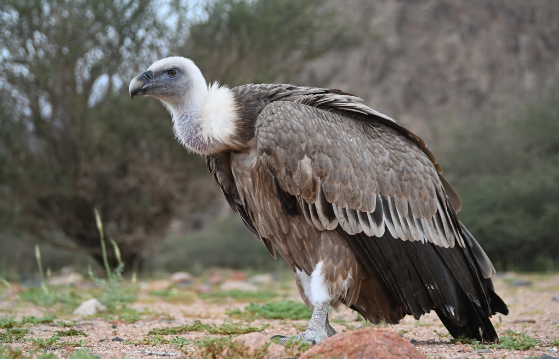
The facilities are expected to support several vulture species found in Saudi Arabia, including the lappet-faced, Egyptian, griffon, cinereous and bearded vultures.
Some of these species breed in the Kingdom, while others visit during winter or migrate through the country. The bearded vulture has become particularly scarce, with no recent breeding confirmed, while the lappet-faced and Egyptian vultures face serious conservation threats.
The NCW plans to monitor feeding stations through camera traps, livestreaming cameras where feasible and field observations conducted from a distance to minimise disturbance to wildlife.
Monitoring teams will record weather conditions, food types and quantities, feeding times, visiting species, bird numbers, age groups and behaviour. They will also track changes in visit frequency and breeding outcomes to assess the programme’s effectiveness.
The centre emphasised that success would not be measured solely by the number of birds visiting the stations. The facilities are intended to supplement natural feeding opportunities rather than make vultures dependent on a permanent artificial food supply.
Food will generally be provided early in the morning to allow birds to feed during daylight hours. The management approach will also include observing other wildlife attracted to the sites.
Vultures play a vital role in ecosystems by consuming animal carcasses, recycling nutrients and reducing the availability of carrion to flies, rodents and stray dogs. Their specialised digestive systems can neutralise many pathogens, helping limit certain disease risks among wildlife, livestock and people.
Saudi Arabia’s location along major migration routes between Europe, Asia, Africa and southern Arabia gives the Kingdom an important role in protecting both resident and migratory populations.
The NCW noted that vultures travelling across extensive desert landscapes may struggle to find food, making carefully managed feeding stations a potentially valuable conservation measure.
The centre also highlighted the need for international cooperation, as vultures cross national borders throughout their migration journeys. While leadership of a regional conservation network would require agreements between participating countries, Saudi Arabia expects the guide to encourage stronger cooperation at local, regional and potentially international levels.