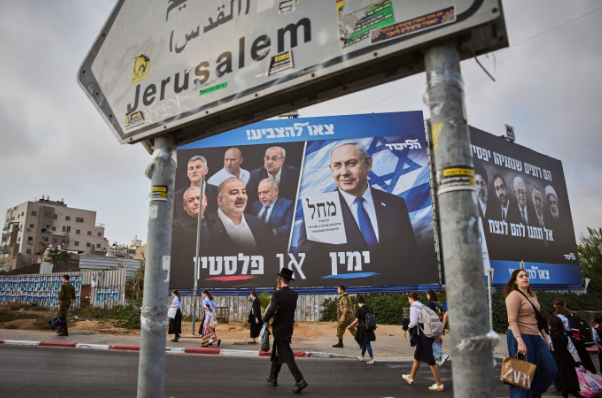
Israeli voters are heading to the polls amid the aftermath of nearly three years of regional conflict following the October 7, 2023, Hamas-led attack, with national security, political accountability and the country’s future direction dominating the election campaign.
The closely contested election is taking place as Israel faces growing international criticism over its military operations in Gaza, expanding settlements and violence in the occupied West Bank. The country has also witnessed a shift towards more hard-right and religious nationalist politics.
The final pre-election opinion polls indicated a tight contest between Prime Minister Benjamin Netanyahu, Israel’s longest-serving leader, and his principal centrist challenger, Gadi Eisenkot, a former military chief who entered politics more recently.
Around 7.3 million Israelis are eligible to vote, including more than 500,000 young people casting ballots for the first time. Surveys suggest that many first-time voters identify with centre-right or right-wing political positions. Tens of thousands of Israelis are also reported to have travelled from abroad to participate in the election.
Speaking ahead of polling day in Jerusalem, 58-year-old real estate agent Uriel Brandler described the vote as one of the most significant in Israel’s history, saying the country needed improvements across multiple areas.
Netanyahu, 77, has served as prime minister for more than 19 years across several terms. During the campaign, he placed considerable emphasis on his security record and relationship with US President Donald Trump, arguing that his leadership was essential to protecting Israel.
Since the October 7 attack, Netanyahu’s government has overseen military campaigns across several fronts. Israeli operations have devastated large parts of Gaza, expanded military activity in Lebanon and included direct strikes against Iran with US involvement. Meanwhile, Israeli communities have faced attacks and bombardment involving Iran, Hamas, Hezbollah and Yemen’s Houthi movement.
Some Netanyahu supporters have defended his leadership on the grounds of experience and security. Zipporah Bennett, an 85-year-old retiree, said she supported him because of his handling of difficult national circumstances and his close relationship with the US administration.
Netanyahu returned to office in December 2022 with the support of far-right and ultra-nationalist parties, which have since gained influence within his governing coalition.
His government has faced criticism from opposition parties over its support for ultra-Orthodox political groups seeking to preserve exemptions from compulsory military service for religious students. The debate has intensified as the Israeli military confronts personnel shortages.
Another major issue in the campaign is the government’s response to the October 7 attack, which marked the deadliest day in Israel’s history. Netanyahu has faced criticism for not accepting responsibility for the security failures preceding the assault.
Eisenkot has pledged to establish an independent state commission of inquiry to investigate the intelligence and security lapses surrounding the attack. Netanyahu’s government has resisted calls for such an investigation.
Eisenkot’s Yashar party is part of an informal opposition alliance that spans right-wing, centrist and centre-left political groups seeking to remove Netanyahu from office. Although Eisenkot has opposed the establishment of a Palestinian state and expressed support for Israeli settlements, he has also promised action against settler violence.
Neither Netanyahu nor Eisenkot has publicly committed to forming a coalition with predominantly Arab political parties, which represent approximately 21 per cent of Israel’s population. These parties could nevertheless play a significant role in determining the formation of the next government if the election produces a closely divided parliament.
The election outcome may not immediately resolve the political uncertainty. No single party is expected to secure the 61 seats required for a majority in Israel’s 120-member Knesset, making coalition negotiations essential.
Final results could take several days to emerge, while negotiations to form a government may continue for weeks or months. If political parties fail to reach an agreement, another election could become a possibility.