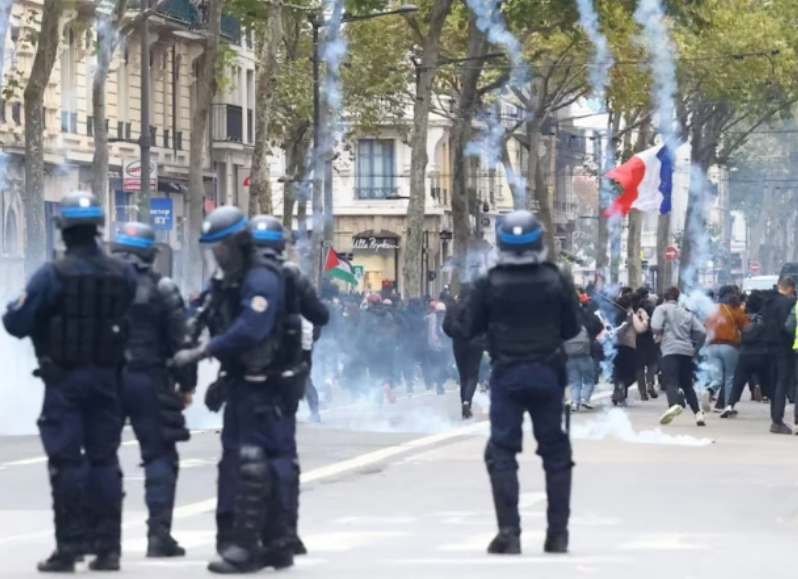
France is bracing for widespread demonstrations and strike action as growing public dissatisfaction over poor educational conditions, rising living costs and economic inequality fuels protests across the country.
The student-led movement, which initially emerged over deteriorating conditions in schools, has expanded amid broader public frustration, culminating in violent unrest on October 17, described as the country’s worst rioting in several years.
Authorities estimate that between 500,000 and 700,000 people could take part in Thursday’s demonstrations nationwide, with up to 80,000 expected to march in Paris.
Marylise Leon of the French Democratic Confederation of Labour (CFDT) described the planned demonstrations as a major mobilisation, predicting participation comparable to the 2023 protests against pension reforms, which attracted more than one million demonstrators.
Several public and private education unions have announced strike action, alongside organisations representing railway workers, hospital employees and postal service staff.
The unions have presented a series of demands to the government and employers, including an increase in the minimum wage, which has not received a discretionary rise since 2012, general salary increases, tax reforms and improved educational facilities and conditions for young people.
Meanwhile, Interior Minister Laurent Nunez announced on Wednesday that approximately 70,000 police officers and security personnel would be deployed nationwide to maintain order. He warned that authorities would respond firmly to any violence or public disorder.
Although student-led demonstrations have largely remained peaceful, some gatherings have witnessed confrontations between protesters and police. Security forces have used tear gas and water cannons to disperse crowds.
An attempted murder investigation was also launched after petrol bombs were thrown at security personnel in Paris on Saturday.
However, the police response has faced criticism, with allegations of excessive force against demonstrators prompting internal investigations. Several teenage protesters have reportedly sustained serious injuries, while thousands of people have been arrested.
Authorities have acknowledged shortcomings in security and intelligence arrangements that contributed to the violence, widespread looting and damage to public property during the October 17 unrest.
In another development, Paris police authorities on Wednesday prohibited a major demonstration route planned between Place de la Bastille and Place de la Concorde, which would have passed through the city centre. Officials instead approved an alternative route heading east, away from central Paris.
Several trade unions criticised the restrictions, describing them as an attempt to limit the right to peaceful demonstrations. Some organisations also filed last-minute appeals seeking permission to use the original routes.
Fabrice Fort of the General Confederation of Labour (CGT) said public support for the student movement remained strong, while restrictions on civil liberties and demonstrations had further intensified public concerns.
He added that the developments had encouraged people who were generally reluctant to express their views publicly to become more involved.
Similar youth-led demonstrations have also emerged in other European countries in recent weeks, including Denmark, Germany and Italy.