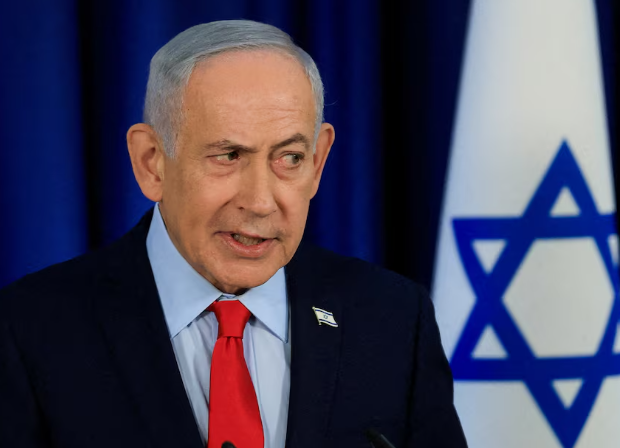
An ultra-Orthodox Jewish party that has long supported Israeli Prime Minister Benjamin Netanyahu declined on Thursday to recommend him for another term, strengthening indications that opposition rival Gadi Eisenkot could be given the first opportunity to form the next government.
President Isaac Herzog held a second day of consultations with political parties following the October 27 election, which left neither Netanyahu nor Eisenkot with enough parliamentary support to secure a majority.
United Torah Judaism, which had backed Netanyahu after the previous five elections, informed Herzog that it would not recommend any member of parliament to form the next government. The party also refrained from endorsing Eisenkot.
According to the president’s office, the party made the decision during its consultation with Herzog. United Torah Judaism holds seven seats in the 120-member Knesset.
United Torah Judaism represents ultra-Orthodox Jews of Ashkenazi background, while the Shas party represents the Sephardic community, primarily comprising people of Middle Eastern and North African descent. Both parties have traditionally supported Netanyahu and sought to preserve exemptions from compulsory military service for religious students.
Netanyahu has maintained these exemptions but has not secured their formal inclusion in legislation. The issue has fuelled widespread resentment among other Israelis, particularly as military reservists continue to serve repeated deployments amid conflicts in Gaza, Lebanon and Iran.
United Torah Judaism lawmaker Isaac Pindrus said the party’s immediate priority in any future government would be to resolve the legal status of religious students studying the Torah.
Eisenkot, a former Israeli military chief seeking to unite centrist and centre-right political forces, has pledged to end the exemptions. Some of his political allies have also criticised the ultra-Orthodox community over its position on military service.
Political observers believe United Torah Judaism’s decision could be intended to pressure Netanyahu and demonstrate that its parliamentary support cannot be taken for granted. However, the party could still join a government led by him if he manages to secure the mandate.
Herzog was scheduled to meet representatives of major political parties later on Thursday before assigning a lawmaker the responsibility of forming a government. The president generally considers the recommendations received from political parties when deciding whom to nominate.
This makes Eisenkot a likely candidate to receive the mandate, although the final decision rests with Herzog.
The lawmaker appointed to form the government will have 28 days to secure an agreement, with a possible extension of 14 days. If the attempt fails, Herzog can assign the task to another politician.
Netanyahu’s political bloc, including United Torah Judaism, holds 53 seats in the new parliament, compared with 48 seats for Eisenkot’s bloc.
Meanwhile, Israeli Arab parties made significant gains, securing 19 seats amid growing opposition to Netanyahu’s hard-right government.
Although Eisenkot could potentially form a coalition with Arab parties, such an arrangement could create divisions within his opposition alliance and risk losing the support of some political partners.