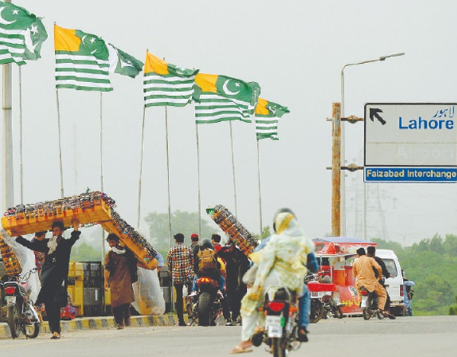
AJK President Sultan Mahmood Chaudhry has said Pakistan and Kashmir share deep-rooted historical and cultural ties, reiterating that the people of Kashmir have never accepted being denied the right to determine their future.
Speaking at a flag-hoisting ceremony at the High Court ground to mark Pakistan’s 79th Independence Day, he said Kashmiris had continued their struggle for self-determination in line with the UN Charter and relevant Security Council resolutions.
Prime Minister Faisal Mumtaz Rathore, minister Syed Bazil Ali Naqvi, Chief Secretary Khushal Khan, senior civil and military officials, political and social figures, students, lawyers, women and a large number of citizens attended the ceremony.
A siren was sounded and participants observed a minute’s silence in memory of the martyrs. The AJK president then hoisted the national flag, while an AJK police contingent presented a salute. Girl Guides and Boy Scouts also performed national songs.
Mr Akbar said the historic resolution on Kashmir reflected the aspirations of the Kashmiri people even before Pakistan’s creation. He said “intrigues and manoeuvrings” by the departing British authorities and Indian leadership had prevented its implementation, resulting in a “grave human tragedy” that continued to affect the region.
He said the Kashmir dispute, which had remained unresolved for nearly eight decades, had turned South Asia into one of the world’s most dangerous nuclear flashpoints, making its peaceful resolution essential for lasting regional stability.
The AJK president said successive generations of Kashmiris had made significant sacrifices, with men, women and children facing killings, imprisonment, displacement and other hardships.
Referring to Kashmiri leaders, he said Syed Ali Shah Geelani and Burhan Wani had become symbols of resistance and sacrifice, while Shabbir Shah, Yasin Malik and Aasiya Andrabi remained incarcerated in India.
He alleged that repression in occupied Kashmir extended beyond political leaders, with journalists, human rights defenders, students, academics, traders and businesspeople facing intimidation, arrests, restrictions and other forms of coercion.
“The targeting of civil society and independent voices has further narrowed the space for dissent and expression in occupied Jammu and Kashmir,” he said.
Mr Akbar expressed gratitude to Pakistan for supporting the Kashmiri cause at international forums and repeatedly calling for the implementation of relevant UN resolutions.
Referring to last year’s military confrontation with India, he said the episode demonstrated Pakistan’s “strength, unity and preparedness” and enhanced its position in the region and the international community.
He maintained that Pakistan was playing an increasingly important role in promoting regional peace and stability and encouraging dialogue for the peaceful resolution of disputes.
Mr Akbar reiterated that the people of AJK stood “shoulder to shoulder” with Pakistanis, saying the destinies of the two sides were intertwined.
He urged Pakistan to continue supporting the people of occupied Kashmir and play its role in securing an early and just settlement of the dispute. He also prayed for Pakistan’s stability, prosperity and security and for the people of Jammu and Kashmir to achieve freedom and the right to determine their own future.