
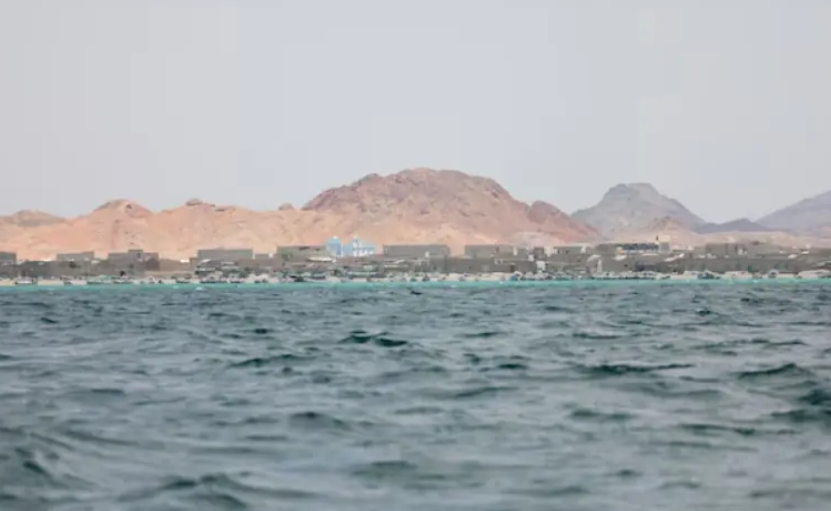
With hundreds killed in recent fighting and the Houthis exchanging strikes with Saudi Arabia, the strategic Bab al-Mandab strait has emerged as a growing flashpoint, raising concerns over one of the world’s key maritime trade routes.
Known in Arabic as the “Gate of Tears” because of its history of shipwrecks, Bab al-Mandab lies at the southern end of the Red Sea, linking the waterway to the Gulf of Aden and the Indian Ocean.
The strait stretches for around 100 kilometres and is about 30km wide at its narrowest point. It separates Yemen from Djibouti and Eritrea on the Horn of Africa.
Bab al-Mandab is a crucial link between Europe and Asia, with oil tankers and cargo vessels using the route to access the Mediterranean through the Suez Canal. The passage significantly reduces travel distances between Asia, Europe and North America.
Shipping through the Red Sea declined sharply after Houthi attacks on vessels during the Gaza war. According to IMF PortWatch data analysed by AFP, total vessel transits fell from 26,895 in 2023 to 14,498 in 2024 and 14,070 in 2025.
Average daily traffic between January and August 2026 stood at 40.8 vessels, remaining well below pre-crisis levels.
Although the Houthis do not control the coastline immediately surrounding Bab al-Mandab, they hold the major port city of Hodeida farther north. A Yemeni military source also told AFP that the group had captured the coastal city of Mokha.
Since declaring a maritime blockade of Saudi Arabia in July, the Houthis have repeatedly targeted Saudi vessels operating in the Red Sea.
The group has denied plans to close Bab al-Mandab or impose transit fees, distinguishing its actions from Iran’s blockade of the Strait of Hormuz.
The Institute for the Study of War has assessed that Houthi attacks are aimed at disrupting Saudi Arabia’s oil exports and increasing the economic and political costs for Riyadh in an effort to pressure it to halt military operations.
Bab al-Mandab was already an important route for global energy supplies before the latest regional conflict. The US Energy Information Administration estimated that around 12 per cent of global oil shipments passed through the strait in 2023.
Following disruptions to shipping caused by Houthi attacks, the closure of the Strait of Hormuz made Bab al-Mandab an increasingly important alternative route for energy shipments.
Saudi crude exports from the Red Sea port of Yanbu rose sharply after the conflict began, averaging around 3.8 million barrels per day between March and July, according to commodities data firm Kpler. This was roughly five times the pre-war level.
However, shipments dropped to around 1.5 million barrels per day in August after the Houthis resumed attacks on Saudi shipping in July. Preliminary Kpler figures showed exports reaching 2.44 million barrels per day during the first nine days of September, although the data remains subject to revision.
Security expert Andreas Krieg of King’s College London said the greatest risk was not necessarily the physical closure of Bab al-Mandab but continued uncertainty surrounding shipping through the strait.
He warned that prolonged instability could further reduce traffic through the Suez Canal, increase costs for Egypt and add time and expense to trade between Europe and Asia.
The latest escalation is linked to the wider regional conflict that began on February 28, when the United States and Israel launched attacks on Iran, prompting Iranian retaliation across the region.
Tensions in Yemen intensified in July after the Houthis allowed an Iranian aircraft to land despite Saudi control of Yemeni airspace. The Yemeni government subsequently struck the airport, triggering renewed fighting and effectively ending a truce that had largely held since 2022.
The Houthis later declared a maritime blockade of Saudi Arabia and stepped up attacks on Saudi tankers and territory.
With the group now expanding its presence closer to Bab al-Mandab, concerns are growing that Iran and its allied groups could gain greater capacity to disrupt Gulf energy exports.
Krieg said any Houthi gains around Bab al-Mandab could provide the group with “extraordinary strategic leverage”. He added that control of the coastline would strengthen its ability to pressure maritime traffic, although the Houthis already have the ability to threaten shipping without controlling the strait itself.