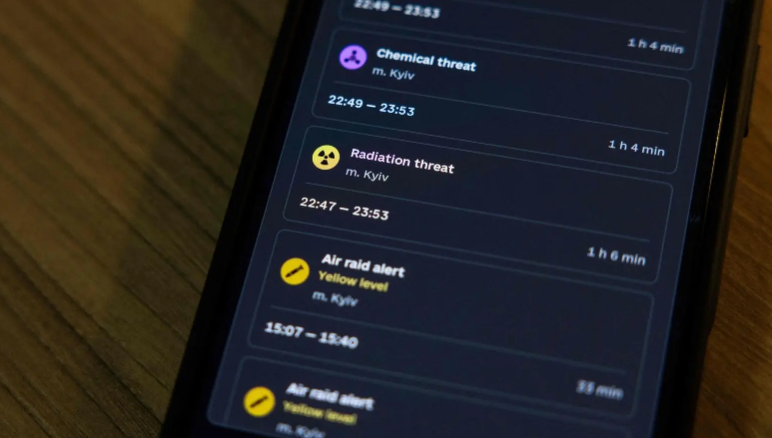
Emergency alert systems in Ukraine and Russia were targeted in cyberattacks that triggered false public warnings, including alerts about nuclear, radiation and chemical threats.
The incidents came shortly after the end of a six-day local ceasefire in a small area of southern Ukraine. The truce, brokered by US First Lady Melania Trump, was the longest pause in fighting since Russia launched its full-scale invasion of Ukraine in 2022.
Ukraine’s public air raid application began issuing false alerts shortly before 2100 GMT on Sunday, warning residents in Kyiv and other areas about radiation and chemical attacks, as well as street fighting.
One notification claimed Russia had launched an Oreshnik hypersonic missile, which can carry a nuclear warhead, and announced a nuclear alert.
Ukraine’s Air Force said the application appeared to have been compromised by Russian hackers. It noted that the false warnings were issued in Russian rather than Ukrainian, the language required for official communications.
In a statement, the Air Force said the alert application appeared to have come under enemy influence and assured the public that there was no radiation threat. It urged residents to remain calm and follow official updates.
All-clear notifications were issued shortly afterwards. Ukraine’s Ministry of Digital Transformation said the application had been temporarily suspended, while air raid sirens and other public warning systems remained operational.
Hours later, Russia’s Emergencies Ministry confirmed that its own mobile application had also been targeted in a cyberattack that resulted in the transmission of fabricated public warnings.
The pro-Ukrainian hacking group Atesh shared a screenshot of the Russian alert on Monday, claiming responsibility for compromising the ministry’s application.
The fake notification, which included profanities and derogatory references to Russian regions, claimed that nuclear warheads had been launched and advised residents to seek shelter in their basements.
Russia’s Emergencies Ministry played down the incident, saying technical specialists were working to restore the affected supplementary application.
The ministry urged people to remain calm and rely exclusively on official information published on its website and verified social media accounts.
In Kyiv, local businessman Artem Pyndyk, 37, said he was briefly startled by the false notifications but soon realised that the messages were not genuine.