
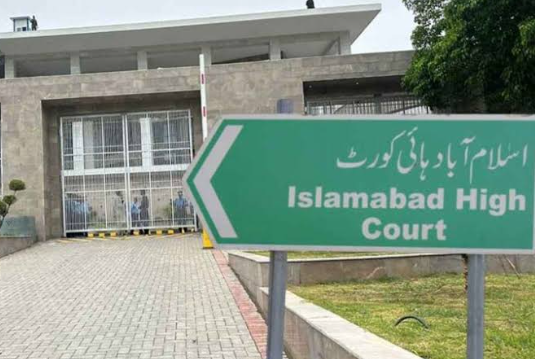
The Islamabad High Court (IHC) has ruled that government agencies cannot restrict a citizen’s foreign travel by placing their name on the Passport Control List (PCL) without lawful authority, due process and a clear legal basis.
Justice Raja Inaam Ameen Minhas, in a detailed judgement, declared the second limb of Rule 22(2)(b) of the Passport Rules, 2021, ultra vires the Passports Act, 1974, as well as Articles 4, 9, 10A and 15 of the Constitution. The court held that the provision had no legal effect.
The judgement came in response to a petition filed by Moinuddin, who was stopped at Islamabad International Airport on Dec 18, 2025, while travelling to Saudi Arabia to perform Umrah. He held a valid Pakistani passport, a Saudi visa and a confirmed air ticket, but was not given a reason for being prevented from travelling.
The court noted that his passport had never been impounded, confiscated, cancelled or inactivated, nor had authorities refused its issuance or renewal. The central issue before the court was whether a government agency could prevent a citizen from travelling abroad while they held a valid passport.
According to the judgement, Moinuddin’s name was placed on the PCL on Dec 24, 2024, following a recommendation by NCB-INTERPOL that was forwarded by an FIA assistant director from the Immigration Wing.
The action followed his deportation from the United Kingdom after he was convicted of causing death by dangerous driving while under the influence of alcohol. He had served a three-year prison sentence before being deported to Pakistan.
The IHC noted that Moinuddin had completed his sentence and that no criminal case, investigation or inquiry was pending against him in Pakistan. He was also not a proclaimed offender and was not facing an extradition request.
The court rejected the authorities’ argument that retaining his name on the PCL was justified because his conduct had damaged Pakistan’s international reputation and that the restriction was intended as a deterrent.
According to the judgement, neither of these grounds was provided for under the Passports Act or the relevant Passport Rules.
The court observed that Rule 21 concerned the refusal of a passport and did not empower authorities to restrict the movement of a person who already possessed a valid passport.
“The refusal of a passport and the prohibition of travel are two separate exercises of power,” Justice Minhas observed.
The judgement further stated that the authority to “prepare and maintain” the PCL was administrative in nature and did not automatically grant officials the power to determine whose name could be placed on the list.
The court also pointed out that Rule 22(2) referred to individuals whose passport facilities had been refused. In Moinuddin’s case, however, his passport had never been refused.
The IHC noted that Rule 22(2)(a) specifically identified the additional secretary of the relevant division as the competent authority for placing and removing names in Category A, while clause (b) did not identify a specific authority.
The court consequently held that neither the FIA Directorate General nor NCB-INTERPOL had the legal authority to place Moinuddin’s name on the PCL under the circumstances of the case.
It further observed that the order placing his name on the list merely referred to approval by a “competent authority” without identifying the authority, specifying the legal provision relied upon or explaining the material considered before the decision was made.
The court found that the disputed provision lacked safeguards such as a designated competent authority, objective criteria, prior notice, an opportunity for a hearing, recorded reasons and communication of the decision to the affected person.
As a result, a citizen could become aware of the restriction only after being stopped at an immigration counter, the judgement noted.
The IHC declared the second limb of Rule 22(2)(b), which allowed PCL placement on recommendations from government agencies or departments, to be beyond the scope of Sections 8 and 13 of the Passports Act and inconsistent with the Constitution.
Addressing the authorities’ reliance on “international reputation” and “deterrence”, the court said that Moinuddin had completed his sentence and was not facing any pending proceedings. Therefore, the restriction had no “live and proximate nexus with a present necessity”.
“Gravity does not supply jurisdiction,” the court observed.
The IHC also expressed displeasure over the authorities’ failure to comply with an earlier court order and directed them to decide Moinuddin’s application within one week through a speaking and reasoned order.
The court set aside the agency’s Jan 26, 2026 order and declared Moinuddin’s placement on the PCL on Dec 24, 2024 to have been made without lawful authority and to be of no legal effect.
Authorities were directed to remove his name from the PCL within 15 days of receiving a certified copy of the judgement and not to prevent his lawful foreign travel on the basis of the disputed placement.
The court clarified that the competent authority could still take any action permitted by law, provided the prescribed legal procedure was followed.
Copies of the judgement were also sent to the Interior Secretary, Director General of Immigration and Passports and Director General of the FIA for compliance.