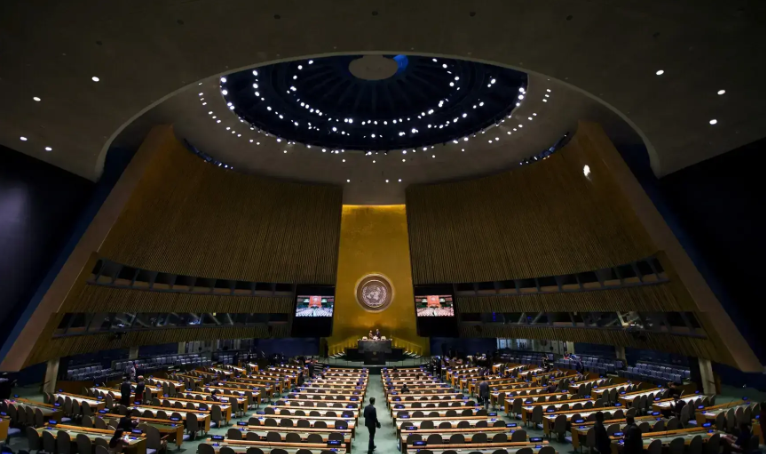
Pakistan has called for a stronger role for the United Nations General Assembly in maintaining international peace and security, particularly when the Security Council is unable to take action, and proposed a dedicated mechanism to monitor the implementation of Assembly resolutions.
Presenting the proposal during a General Assembly plenary session on Friday, Pakistan’s First Secretary Ansar Shah said revitalising the world body required political commitment to enable the Assembly to fully exercise its authority under the UN Charter.
“A revitalised General Assembly is essential to a revitalised United Nations,” Mr Shah said.
Pakistan proposed that the UN Secretariat regularly submit detailed reports on the implementation of General Assembly resolutions, arguing that systematic monitoring would strengthen accountability and help translate decisions into practical action.
The proposal seeks to address a longstanding challenge within the international system, where resolutions concerning conflicts and disputes often remain unimplemented for years without systematic assessments of progress.
Pakistan also called for more frequent and substantive reports from the Security Council to the General Assembly to promote transparency and improve coordination between the two principal UN bodies.
Under the UN Charter, the Security Council holds primary responsibility for maintaining international peace and security. Its five permanent members — China, France, Russia, the United Kingdom and the United States — each possess veto power over substantive resolutions, allowing any one of them to block collective action.
Differences among major powers have repeatedly complicated international responses to conflicts, prompting calls for a greater role for the General Assembly, which comprises all 193 UN member states.
Pakistan’s proposal aims to improve the Assembly’s effectiveness within the authority granted to it under the UN Charter rather than replace the Security Council.
Ongoing conflicts in Gaza and tensions involving the United States and Iran have highlighted the difficulties of securing timely international responses when major powers remain divided.
For Pakistan, the implementation of UN resolutions holds particular importance in relation to Palestinian self-determination and the unresolved Kashmir dispute, which Islamabad maintains should be settled in accordance with relevant UN resolutions.
The proposed monitoring mechanism would enable member states to assess whether resolutions were being implemented, identify areas where progress had stalled and strengthen accountability for commitments made by the international community.
Mr Shah said revitalising the General Assembly should be a political undertaking aimed at restoring balance, equity and democratic participation within the United Nations, rather than merely changing administrative procedures.
Pakistan also supported streamlining the Assembly’s agenda, rationalising resolutions and placing greater emphasis on practical outcomes. The Pakistani delegate highlighted the Assembly’s role in the peaceful settlement of disputes, including through mediation.
The broader objective, he indicated, was to restore confidence in multilateral institutions by ensuring that their decisions carried greater practical weight and that member states were held accountable for implementation.