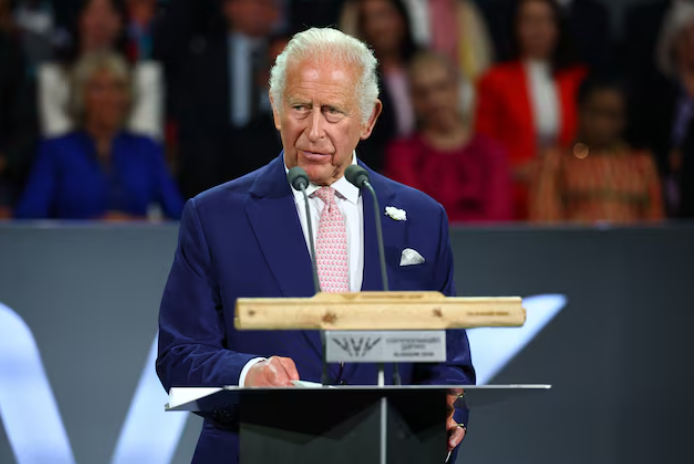
King Charles III has described slavery as a “monstrous injustice”, acknowledging its lasting impact on Caribbean nations and other members of the Commonwealth.
Addressing the Commonwealth Heads of Government Meeting in Antigua and Barbuda, the British monarch said slavery continued to cast a shadow over several countries belonging to the 56-member organisation, many of which were former British colonies.
The king expressed deep sorrow over the historical slave trade, describing it as a shameful chapter in history. He also highlighted the role of courage and determination in ending the international trade in enslaved people, particularly the contribution of the Royal Navy.
His remarks come as UK Prime Minister Burnham considers calls for a formal apology for Britain’s historical involvement in slavery.
Historical estimates suggest that between 10 and 15 million Africans were forcibly transported to the Americas over approximately four centuries through the transatlantic slave trade.
The British Parliament passed legislation in 1833 to abolish slavery across most of the British Empire.
However, Conservative opposition leader Kemi Badenoch has opposed issuing a formal apology, arguing that it could strengthen demands for financial compensation from countries affected by slavery.
Prime Minister Burnham has indicated that he is open to apologising for Britain’s role in the slave trade but has ruled out financial reparations demanded by several Caribbean nations.
The issue has remained a source of tension between Britain and its former colonies, with calls for historical accountability continuing to affect relations within the Commonwealth.
King Charles, whose family historically benefited from the slave trade, is not expected to issue a formal apology, as the monarch maintains a politically neutral position. Buckingham Palace has also indicated that announcing changes to government policy would not be appropriate for the king.
During the summit, Burnham held discussions with Barbados Prime Minister Mia Mottley regarding Britain’s proposed structured dialogue with communities affected by the transatlantic slave trade.
In a recent article, Burnham said he was prepared to engage in difficult discussions to protect the future of the Commonwealth, adding that listening to demands for a formal apology would be an important part of the process.
However, he maintained that financial reparations were not an appropriate solution, arguing that present-day British citizens should not be held financially responsible for historical injustices.
Instead of financial reparations, the British government is pursuing a proposed debt restructuring initiative for the poorest Commonwealth countries, led by former prime minister Gordon Brown.
The initiative aims to ease financial pressure by potentially revising interest rates on existing debt repayments.
Britain has also announced $54 million in funding over three years for infrastructure development across Caribbean countries, including renewable energy projects.
The issue of slavery and its historical consequences has remained a central theme during King Charles’s nine-day visit to three Caribbean nations.