
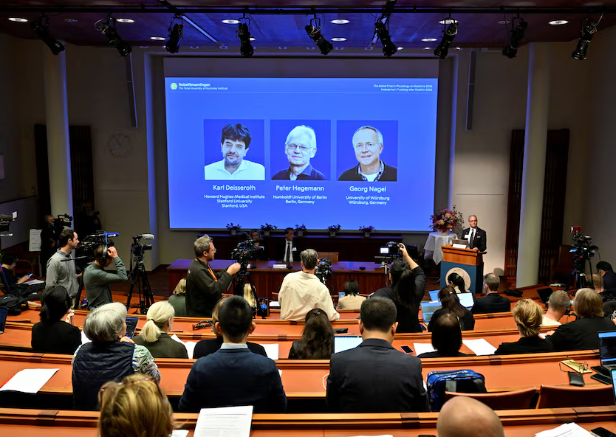
German scientists Peter Hegemann and American researchers Karl Deisseroth and Ed Boyden have been awarded the Nobel Prize in Physiology or Medicine for discoveries that have advanced understanding of how nerve cells function.
The Nobel Assembly at Sweden’s Karolinska Institutet said the three scientists were recognised for their discoveries involving light-sensitive ion channels and the development of optogenetics.
Optogenetics enables researchers to control the activity of individual nerve cells in a living brain by using light. Nobel Assembly Secretary-General Thomas Perlmann said the technique is now being used in laboratories around the world to study the brain.
The technology is also being explored for potential medical applications. Clinical trials are examining whether light-sensitive proteins can be introduced into the retina to help restore vision in people affected by retinitis pigmentosa.
Researchers are also investigating whether optogenetics could improve cochlear implants by enabling more precise stimulation of auditory nerves than conventional electrical devices.
The three laureates will share a prize of 12 million Swedish crowns, equivalent to about $1.2 million.
Hegemann began studying the response of the single-celled alga Chlamydomonas to light in the early 1990s. He proposed that a specific protein could detect light and function as an ion channel.
Ed Nagel later tested the theory by introducing genes from Chlamydomonas into frog eggs. The experiments led to the discovery of channelrhodopsin-2, a light-sensitive ion channel that opens when exposed to light.
Hegemann and Nagel reported in 2003 that the protein could be introduced into human and hamster cells, allowing light to trigger electrical activity.
In 2005, Deisseroth and his colleagues at Stanford University demonstrated that the technique could be used to control nerve cells in rats. The approach was subsequently named optogenetics.
Perlmann said he spoke with all three laureates after the announcement and described them as surprised and delighted by the recognition.
He said the scientists were particularly pleased to receive the award together and described each other as friends.
The Nobel Prizes were established under the will of Swedish inventor and industrialist Alfred Nobel and have been awarded since 1901, with limited interruptions, mainly during the two World Wars.
The economics prize was introduced in 1968 by Sweden’s central bank, Sveriges Riksbank.
The Nobel Prize in Physiology or Medicine has recognised several major scientific breakthroughs, including Alexander Fleming’s discovery of penicillin and Karl Landsteiner’s identification of human blood groups.
Last year, American scientists Mary Brunkow and Fred Ramsdell, along with Japan’s Shimon Sakaguchi, received the medicine prize for research explaining how the immune system prevents attacks on healthy cells.
Nobel laureates are selected by expert committees appointed by the institutions responsible for each award. Most prizes are presented in Stockholm, while the Nobel Peace Prize is awarded in Oslo.
The annual Nobel celebrations culminate on December 10, the anniversary of Alfred Nobel’s death. Laureates receive their awards during ceremonies attended by members of the Swedish and Norwegian royal families, followed by formal banquets.