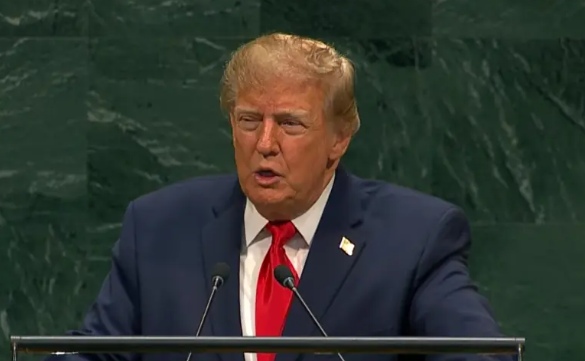
The US president highlighted the Pakistan-India conflict, the war in Iran, artificial intelligence and international institutions during his address to the United Nations General Assembly.
He said his administration had helped settle several conflicts since taking office and attributed the progress to diplomatic relations and economic measures, including tariffs.
While listing conflicts involving Pakistan and India, Thailand and Cambodia, Armenia and Azerbaijan and Gaza, he said leaders from several countries had expressed appreciation for his efforts.
He also cited remarks by Pakistan’s prime minister, who he said had credited US efforts with helping save millions of lives during the Pakistan-India conflict.
Tensions between Pakistan and India escalated in April 2025 following a deadly attack in occupied Kashmir. Pakistan rejected allegations linking it to the incident. The two countries subsequently exchanged military strikes before agreeing to a ceasefire in May.
The US president has repeatedly highlighted his role in facilitating the ceasefire and has continued to discuss the military escalation between the two nuclear-armed neighbours.
The US president also addressed the conflict with Iran, saying military action had prevented Tehran from obtaining a nuclear weapon and warning of further escalation if a peace agreement was not reached.
He said he expected negotiations to resume after the US midterm elections and urged countries to support economic measures aimed at increasing pressure on Iran.
Iran has consistently denied seeking to develop nuclear weapons.
The US president also said an agreement between Russia and Ukraine to end the war could be reached, saying Washington was engaging with both sides to facilitate a settlement.
The US president called on countries that are members of the International Criminal Court (ICC) to withdraw from the organisation, describing it as an institution operating beyond its authority.
The United States is not a member of the ICC and has never ratified the Rome Statute that established the court. Israel, Russia and China are also not members.
Washington has previously imposed sanctions on ICC officials following the court’s actions involving Israeli leadership.
The US president rejected proposals for international oversight of artificial intelligence, arguing that global regulation could restrict technological development.
He also said the US government would use the term “super intelligence” instead of artificial intelligence in its official communications.
The remarks came as governments and technology experts continue to debate safeguards for increasingly capable AI systems. More than 20 countries have called for binding safety measures for advanced AI, warning that technological development could outpace existing safeguards.
The UN secretary-general has called for greater dialogue between major AI powers, including the United States and China, on transparency, cooperation and the management of risks associated with advanced AI.
The United States and China are also discussing mechanisms for communication on AI-related risks as both countries compete for technological leadership.
Pakistan’s prime minister also held meetings with the leadership of Kuwait, Kenya and Somalia on the sidelines of the UN General Assembly session in New York.
During the meetings, discussions focused on bilateral relations, trade, investment, energy, human resource development and other areas of mutual cooperation.
Regional and international developments were also discussed, with the meetings highlighting the importance of peace, stability and economic cooperation.