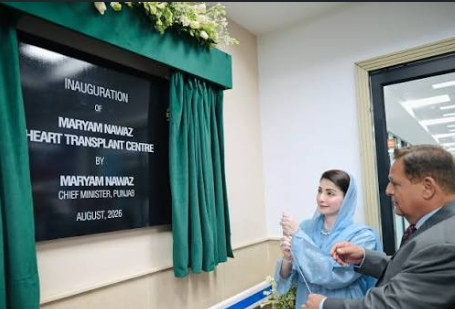
Punjab Chief Minister Maryam Nawaz has announced that heart transplant procedures at Lahore’s newly established Jinnah Institute of Cardiology (JIC) will be provided free of cost to deserving patients.
Speaking at the inauguration of the facility, she said the provincial government would bear up to $50,000 for each heart transplant. She added that the use of Chinese technology could reduce the cost of the procedure to around $10,000, allowing more patients to benefit.
The chief minister formally inaugurated the 250-bed JIC, a state-of-the-art facility built at a cost of Rs16 billion near Jinnah Hospital’s residential area. The autonomous institute has been equipped with a catheterisation laboratory, MRI, modular operation theatres, cardiac wards, pathology and radiology laboratories, intensive care units and emergency services.
Maryam also praised UK-based cardiologist Dr Hasnat Khan for returning to Pakistan to serve patients. Dr Khan said he would assist in training doctors and other staff at the institute.
The chief minister urged medical professionals to provide patients with quality care and stressed the need to change the perception that advanced treatment was only available abroad.
She said the JIC was now fully operational and had already started performing angiography procedures. She also directed the Infrastructure Development Authority Punjab (IDAP) to complete the Medical District at the earliest.
Maryam announced plans to introduce home dialysis machines across Punjab and said the growing burden of heart disease had made it difficult for a single public hospital to meet the healthcare needs of patients from Punjab, Gilgit-Baltistan, Azad Jammu and Kashmir and Khyber Pakhtunkhwa.
She said public hospitals treated around 100 million people last year, with medicines, surgeries and procedures provided free of charge in many cases.
However, the chief minister acknowledged shortcomings in the public healthcare system, alleging that medicines, injections and insulin were sometimes stolen, while some staff demanded payments from patients and hospital equipment was deliberately kept dysfunctional.