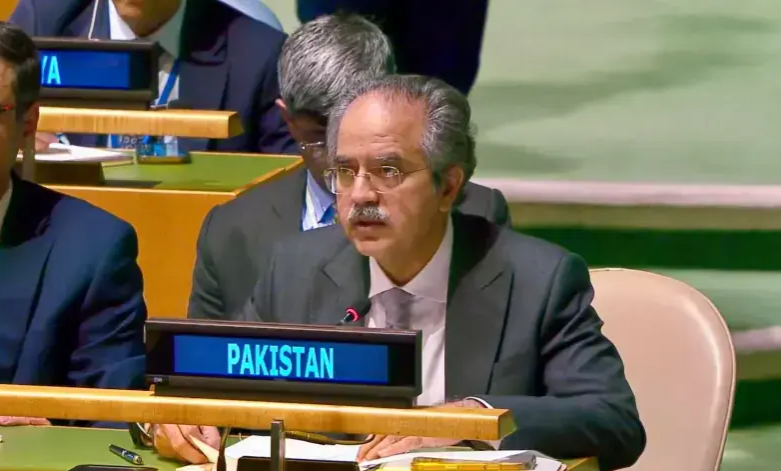
Pakistan’s outgoing Permanent Representative to the United Nations, Ahmad, has returned to Islamabad after two years in New York to take charge as the country’s new foreign secretary.
Ahmad arrived in New York in October 2024 for his third assignment at the United Nations as Pakistan prepared to begin its two-year elected term on the UN Security Council (UNSC). He had previously served on Pakistan’s UNSC teams during 2003-04 and 2012-13.
Describing his assignment as a significant honour, Ahmad said representing Pakistan at the United Nations, particularly at the Security Council, had been a major responsibility.
His tenure coincided with a series of major international crises, including the military confrontation between Pakistan and India in May 2025, the continuing conflict in Gaza, the Israel-Iran war and growing divisions within the international system.
Ahmad said Pakistan brought extensive diplomatic expertise and institutional experience to its eighth term on the UNSC. He said Islamabad focused its efforts on international peace and security, conflict prevention, peaceful dispute settlement, peacekeeping, counterterrorism and cooperation with regional organisations.
Relations between Pakistan and India deteriorated sharply within months of Ahmad’s arrival, culminating in a four-day military confrontation in May 2025 that raised concerns about a wider conflict between the two nuclear-armed neighbours.
The United Nations repeatedly urged both countries to de-escalate tensions and offered its good offices to support dialogue. Ahmad kept UNSC members and other UN delegations informed about Pakistan’s position and concerns over further escalation.
The two countries agreed to a ceasefire on May 10.
Ahmad highlighted Pakistan’s subsequent diplomatic efforts at the UNSC, particularly Resolution 2788, which was unanimously adopted during Pakistan’s presidency of the council in July 2025. The resolution called for greater use of mechanisms under the UN Charter to peacefully resolve disputes.
He described the resolution as an important achievement and said Pakistan was able to build consensus around the issue despite deep divisions within the Security Council.
Ahmad also called for reforms to the UNSC, arguing that the council should become more democratic, representative and accountable.
Pakistan, he said, continued working with the Uniting for Consensus group and other countries in favour of expanding elected membership rather than adding new permanent members.
The Gaza conflict was another major focus of Pakistan’s diplomatic efforts during Ahmad’s tenure.
Pakistan repeatedly raised the Palestinian issue at the UNSC and General Assembly, calling for an end to civilian suffering, respect for international law and progress towards Palestinian self-determination and statehood.
Ahmad said Pakistan played a strong diplomatic role on the issue and supported initiatives aimed at securing a ceasefire, expanding humanitarian access and restoring a political path towards a two-state solution.
The Israel-Iran conflict and subsequent US strikes on Iranian nuclear facilities presented another significant diplomatic challenge for Pakistan, particularly given its close geographical and regional ties with Iran.
Ahmad said Pakistan played a role in diplomatic efforts between Washington and Tehran, contributing to the ceasefire process, Islamabad talks and the eventual signing of the Islamabad Memorandum of Understanding in June 2026.
He said Pakistan remained engaged with all sides and international partners to support diplomatic efforts and promote regional peace.
Pakistan also used its UNSC membership to raise concerns over attacks against UN peacekeepers.
In June 2026, Pakistan and Denmark jointly led Resolution 2823 on accountability for attacks against UN peacekeeping personnel. The resolution was unanimously adopted and received 153 co-sponsors, which Ahmad described as a record level of support for a Security Council resolution on the issue.
The Kashmir dispute remained another key element of Pakistan’s diplomatic agenda. Pakistan organised several Arria Formula meetings to highlight the Jammu and Kashmir issue and called for its peaceful resolution in accordance with relevant UN Security Council resolutions.
Beyond major conflicts, Pakistan remained active in discussions on development, climate change, emerging technologies and the UN80 initiative.
Ahmad also highlighted Pakistan’s contributions to discussions on artificial intelligence, digital assets and tokenisation for development, as well as its role in advancing a General Assembly resolution on access to assistive technologies.
Ahmad’s final major assignment at the UN was the 81st General Assembly session in September, during which he led Pakistan’s mission through a series of diplomatic engagements and Prime Minister Shehbaz Sharif’s visit and address to the Assembly.
On September 10, Ahmad was designated as Pakistan’s next foreign secretary.
He held his farewell meeting with UN Secretary-General António Guterres on September 30. Guterres thanked Pakistan for its contribution to the United Nations and congratulated Ahmad on his new appointment.
The Pakistan Mission in New York later hosted a farewell event for Ahmad and his family, attended by mission officials, consulate representatives and their families.
Ahmad leaves New York after two years marked by major international conflicts, diplomatic tensions and uncertainty, during which Pakistan sought to use its UNSC seat to promote peaceful dispute resolution, strengthen the protection of UN peacekeepers and advocate for a more representative Security Council.