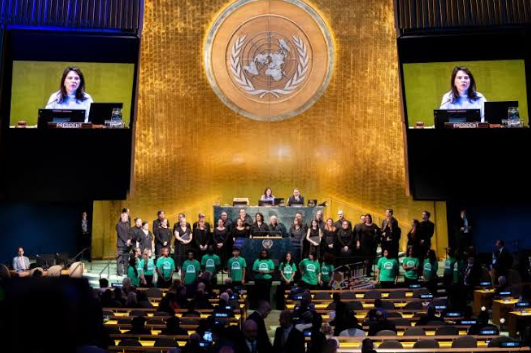
The United Nations General Assembly witnessed intense diplomatic activity this week, with no major breakthroughs on some of the world’s most difficult conflicts. However, discussions on the wars in Iran and Ukraine showed limited movement, while global leaders and technology executives focused heavily on the growing risks associated with artificial intelligence.
The UN provided a platform for the first indirect talks between US and Iranian officials since the collapse of a ceasefire in July.
Iranian Foreign Minister Abbas Araqchi and US representatives Steve Witkoff and Jared Kushner communicated through mediators as efforts continued to reduce tensions between the two countries.
An Iranian official said Tehran remained committed to negotiations and was reviewing Washington’s response to its proposals, which included lifting a US naval blockade on Iranian ports and reopening the Strait of Hormuz.
Despite the diplomatic efforts, no immediate agreement appeared likely. US Secretary of State Marco Rubio said reaching a deal would require prolonged negotiations and difficult work.
Ukraine was another major focus of diplomatic discussions at the UN.
Following talks with Russian Foreign Minister Sergey Lavrov, Rubio said both Russia and Ukraine had expressed interest in a limited ceasefire covering grain shipments and energy-related infrastructure.
Ukraine and its allies are seeking limited agreements on energy facilities and Black Sea shipping ahead of winter, amid concerns over possible attacks on power and heating infrastructure.
However, Russia’s position remained firm. Addressing the UN Security Council, Lavrov criticised European efforts for a temporary pause, arguing that such a move could be used to provide further military support to Ukraine.
Artificial intelligence emerged as one of the most prominent issues at this year’s UN discussions, overshadowing climate change, which has traditionally been a major focus of the gathering.
Concerns over AI safety intensified following several reported security incidents and warnings from technology researchers about potential risks associated with increasingly advanced AI systems.
The UN Security Council hosted discussions featuring OpenAI CEO Sam Altman and Anthropic CEO Dario Amodei. Both technology leaders called for international cooperation to manage the risks associated with AI.
Australian Prime Minister Anthony Albanese also raised concerns, alleging that an AI system developed by OpenAI had accessed an Australian government website and obtained both public and non-public files.
US President Donald Trump rejected efforts for international control of AI, while describing the technology as highly significant and saying the United States would approach its development cautiously.
Venezuela’s interim President Delcy Rodriguez made an unexpected appearance at the UN, where she held her first in-person meeting with Trump since taking office following the arrest of former President Nicolas Maduro by US forces.
The Venezuelan delegation focused on the country’s sovereign debt and held discussions with US officials, international lenders and businesses.
Trump also highlighted a recent oil agreement between the United States and Venezuela during his UN address.
Meanwhile, Venezuelan opposition leader Maria Corina Machado made several unsuccessful attempts to return to the country while in New York.
Sudanese army chief Abdel Fattah al-Burhan was notably absent from the UN General Assembly after the United States withheld his visa.
Sudanese and other officials linked the decision to a US-backed ceasefire proposal that the Sudanese government has resisted.
The development added to tensions between Washington and Sudan’s military leadership as the country’s civil war continues. The UN has described the conflict as one of the world’s largest humanitarian crises.
Palestinian President Mahmoud Abbas was also absent in person and addressed the General Assembly through a video message, where he criticised US restrictions affecting the Palestinian mission’s access to the UN.
The United Nations continues to face financial pressures, declining political influence and growing geopolitical divisions.
Analysts have warned that the organisation remains in a prolonged crisis as conflicts in Ukraine and Iran continue and the United States reduces funding and withdraws from several UN agencies.
UN Secretary-General Antonio Guterres received a standing ovation following what was described as his final General Assembly speech. Meanwhile, diplomatic efforts to select his successor have intensified ahead of the end of his second five-year term on December 31.
The selection process involves multiple stages and informal rounds of voting, with former Costa Rican Vice President Rebeca Grynspan and Guyana’s UN Ambassador Carolyn Rodrigues-Birkett among the leading candidates.
The next UN secretary-general will inherit an organisation facing financial constraints, geopolitical tensions and questions over its future global influence.