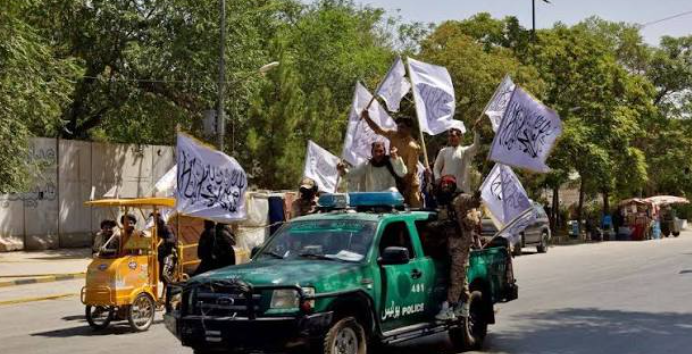
The Taliban marked five years in power in Afghanistan on Saturday with military parades and celebrations in Kabul, as international organisations warned of worsening humanitarian conditions and continued restrictions on women and girls.
Taliban armoured vehicles participated in a parade outside the former US embassy in Kabul, carrying flags and banners as the government celebrated what it described as “victory day” over Western forces.
Interior Minister Sirajuddin Haqqani said in a video address that the Taliban’s return to power had been achieved through “morale, courage” and “divine assistance”. He also acknowledged that “issues and problems” remained.
The celebrations came as the United Nations and aid organisations raised concerns over Afghanistan’s humanitarian situation, with women continuing to face severe restrictions under Taliban rule.
The Taliban have also faced a series of attacks targeting officials in the northeastern province of Badakhshan. The provincial information director was killed in an attack in late July that was claimed by Islamic State, while local media reported that the mayor of the provincial capital was killed in another attack on Thursday. Taliban officials had not immediately confirmed the reports.
The Taliban returned to power in August 2021 following the withdrawal of US and allied forces. They had initially pledged to adopt a more moderate approach than during their previous rule in the late 1990s and early 2000s.
However, rights groups say those assurances were not fulfilled. Since 2021, the Taliban have imposed sweeping restrictions on women and girls, including barring around 2.5 million girls from secondary education and universities, according to Unesco.
Restrictions on women’s movement have also intensified. UN Women said recently that half of Afghan women now leave their homes only once or twice a month.
The Taliban maintain that women’s rights are protected under their interpretation of Sharia law.
Five years after their return to power, the Taliban government remains largely isolated internationally, with Russia currently the only country to have formally recognised it.
Despite the lack of formal recognition, the Taliban have made gradual diplomatic and economic advances, with several countries maintaining engagement with Kabul.
The Afghan authorities have also sought arrangements with European countries over the deportation of Afghan nationals and have used the country’s strategic location between South and Central Asia and the Middle East to pursue economic agreements.
Zia Ahmad Takal, deputy spokesman for the Taliban foreign ministry, said ceremonies marking the fifth anniversary were expected to be held in Pakistan, China, Uzbekistan, Iran, Turkiye and Malaysia.
Humanitarian needs reach record level
The International Rescue Committee warned that Afghanistan’s humanitarian needs had reached a record level, citing drought, deadly earthquakes and the return of Afghan nationals from neighbouring Iran and Pakistan as major factors.
The organisation said the number of Afghans requiring humanitarian assistance had increased by 3.5 million since the Taliban takeover, despite a decline in international aid funding.
The United Nations also called for greater efforts to address the country’s long-term humanitarian and development challenges.
Georgette Gagnon, a senior UN representative on Afghanistan, said lasting peace and prosperity required more than an end to conflict and stressed the importance of ensuring the rights and potential of all Afghans.
For many Afghans, economic hardship remains a major concern.
Fatima, a 28-year-old woman, returned to Afghanistan last year after being deported from Iran, where she had worked as a makeup artist. She said she was struggling to meet basic living expenses while worrying about her child’s future.