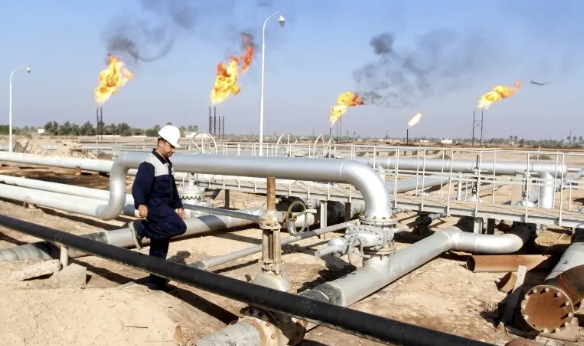
Basra, a major centre of Iraq’s oil industry and a key contributor to the country’s economy, is facing growing economic pressures after disruptions to oil exports through the Strait of Hormuz.
The slowdown has left fuel trucks idle, reduced work for private contractors and forced some companies to cut salaries or lay off employees. Oil fields and operations at the Umm Qasr cargo port have also been scaled back.
Oil exports account for nearly 90 per cent of Iraq’s foreign revenue and are largely transported through the Strait of Hormuz via facilities around Basra, making the city particularly vulnerable to disruptions along the key shipping route.
Before the conflict began, Iraq was producing around four million barrels of crude oil per day and exporting approximately 3.4 million barrels, most of them through Hormuz. The disruption caused storage facilities to fill rapidly, forcing the country to reduce production.
The crisis has highlighted Iraq’s heavy dependence on oil and the vulnerability of its economy to disruptions in its main export route. Efforts to diversify the economy have faced challenges including a weak private sector, limited banking capacity and ageing infrastructure.
Iraq has attempted to use alternative export routes, including road transport through Syria and a pipeline to Turkey, but these routes can handle only a limited share of the country’s oil exports.
Oil shipments through Hormuz began to recover in early September, but some crude was reportedly sold at discounted prices. Iraq’s average oil exports have reached around 2.6 million barrels per day so far this month.
A special exemption for Iraqi tankers and efforts to establish a secure shipping corridor have provided some relief, but the economic impact remains significant.
The disruption has contributed to higher prices and fluctuations in the Iraqi dinar. Foreign currency reserves have also fallen by around $20 billion, according to government figures.
Iraq depends heavily on oil revenues to pay public-sector salaries, finance imports and support the national currency. The decline in oil income has forced the government to rely more heavily on domestic borrowing.
The disruption has also affected Umm Qasr, Iraq’s main southern commercial port, where activity has fallen sharply.
Only a small number of vessels remain at the port, while several newly built berths are largely unused. Reduced activity has affected port workers, including those whose income was supplemented by incentives linked to port profits.
The slowdown at the port has also affected businesses across Basra. Higher import costs, reduced salaries, job losses and the departure of foreign workers from the oil sector have weakened consumer demand.
Businesses dependent on oil and port activity have reported significant declines in sales as households reduce spending amid concerns over delayed salaries and further economic difficulties.
The disruption has exposed the wider impact of the conflict on Iraq’s economy, particularly its dependence on oil exports and maritime trade through the Strait of Hormuz.