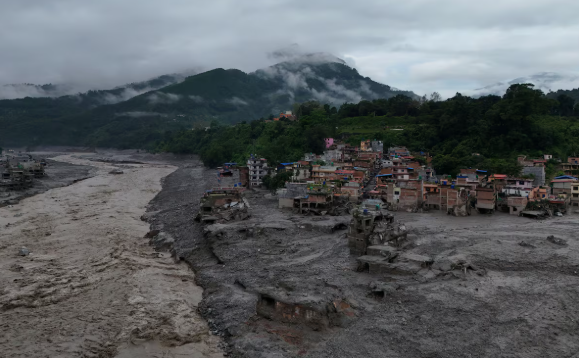
The search for missing people continued in Nepal and neighbouring Tibet on Thursday, two days after a glacier collapse triggered a massive torrent of rock, ice, mud and debris through Himalayan river systems.
The disaster swept through villages and valleys, destroying roads, bridges and power facilities along a key route connecting Kathmandu with Lhasa that is also used by trekkers and pilgrims.
At least 540 foreigners are among those reported missing, while authorities in Nepal deployed helicopters to search for survivors and deliver emergency supplies to thousands of people stranded in remote towns and valleys. Rescue teams, including units with sniffer dogs, also recovered dozens of bodies carried downstream.
Dibga Tamang was among the last survivors rescued from the badly affected town of Rasuwa on Thursday. He was airlifted with three others to an army camp in Nuwakot.
“All of our people have gone. They are dead,” Tamang said, describing the devastation as complete.
The large volume of water and debris has raised fears of another disaster, with authorities warning that newly formed lakes could burst their natural barriers.
Nepal’s disaster management authority said a lake created by debris blocking the Bhotekoshi River was continuing to rise and could overflow.
Across the border, Chinese authorities warned that around three million cubic metres of water — equivalent to roughly 1,200 Olympic-sized swimming pools — could enter an already dammed lake over the next three days.
Chinese state media, citing the Ministry of Water Resources, reported a high risk of the lake breaching, with the peak flow expected around Sept 1.
China has deployed an eight-member engineering team to conduct aerial surveys and three-dimensional modelling of the lake and its debris barrier. Access to the site remains difficult because the glacier collapse created isolated and steep cliffs around the lake.
Engineer Chen Hanxiao told state broadcaster CCTV that one possible way to reduce the threat would be to excavate a drainage channel through a lower section of the dam. However, engineers first need to calculate the required width and depth based on the rate of water flow and the speed at which the lake is filling.
The team will also monitor the lake, collect data from its floor and track weather conditions in the coming days.
Chinese rescue teams had not yet reached the worst-hit area on the Chinese side, the Gyirong border crossing, by Thursday evening, according to state media.
Crews were clearing debris from the main road leading to the crossing, while footage from Wednesday showed torrents of muddy water and debris sweeping through buildings and engulfing people attempting to escape.
Chinese state broadcaster CCTV reported that 558 people remained missing in Gyirong County, including 260 foreign nationals. Three deaths had so far been confirmed on the Chinese side.
Chinese Premier Li Qiang visited the disaster-hit area in Gyirong on Thursday, according to Xinhua, underscoring the seriousness with which Beijing was treating the disaster.
Families of missing people around the world continued to seek information about their relatives.
Sneha Sudhir was among relatives anxiously awaiting news of 10 women’s husbands who had travelled from Nepal to Tibet’s Mount Kailash. The men, all from northern Virginia, were among dozens of Americans reported missing.
Sudhir said the families were supporting one another and contacting officials, politicians and relatives in the United States and India in an effort to locate the missing trekkers.
US President Donald Trump said Washington had offered assistance to Nepal, describing the destruction caused by the floods as unprecedented.
In Nepal’s Chitwan district, administrator Ganesh Aryal said authorities had recovered 103 bodies from the river system. The district is around 100 kilometres downstream from the worst-hit area around the Trishuli River.
With local hospitals unable to accommodate all the bodies, authorities were erecting tents and making arrangements for families to identify and collect the remains of their relatives.
Prime Minister Balendra Shah, who visited flood-hit Nuwakot on Thursday, said the situation remained difficult.
He said government agencies were operating at full capacity, with the immediate priorities being the rescue of missing people, treatment of the injured and provision of emergency assistance to affected families.
The disaster represents a major challenge for Mr Shah’s five-month-old government, although officials said Nepal had extensive experience in responding to large-scale emergencies, including the 2015 earthquake that killed nearly 9,000 people.