
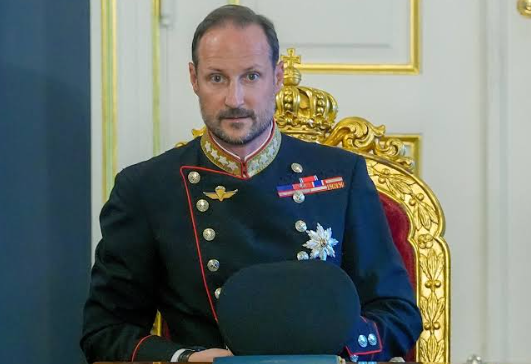
Norway remained in mourning on Saturday as flags flew at half-mast and residents continued to gather outside the Royal Palace in Oslo to pay tribute to the late King Harald, who spent 35 years on the throne.
More than 20,000 people had visited the palace on Friday to offer their condolences, leaving large piles of flowers outside the royal residence.
Tributes also came from European royal families and world leaders, including US President Donald Trump, who remembered the late monarch as “a strong, proud, and greatly respected man”.
“Everyone is sad, and the king was a man whom everyone respected. A fine man, so I think everyone feels a bit down today,” 35-year-old Anne Lobbe said outside the palace.
A national period of mourning has been declared in Norway, while no date has yet been announced for the late king’s funeral.
The new monarch, King Haakon VIII, was scheduled to hold audiences with the leaders of the Church of Norway, parliament and Supreme Court. He will formally swear an oath of allegiance before parliament on Tuesday.
The 53-year-old monarch inherits a royal institution widely regarded for its modern and modest character but which has faced a series of controversies in recent years.
“An era has ended. A new one begins. The king is dead. Long live the king,” Prime Minister Jonas Gahr Store said after meeting the new king on Friday.
Municipal authorities across Norway opened condolence books on Saturday, allowing citizens to record their personal tributes.
In Oslo, 68-year-old Unni Zetterquist Thorsen was among the first to sign the book at City Hall. She said she had thanked the late king for his “patience and strength through difficult times in Norway”, describing him as a source of stability.
The late king’s coffin was transferred from Oslo University Hospital to the Royal Palace on Friday. The public will be allowed to pay their respects at the palace chapel, with dates to be announced.
King Haakon and Queen Mette-Marit are not expected to undergo a coronation ceremony, as Norway abolished the practice in 1908. However, the new king may choose to have his reign blessed at a ceremony in Trondheim Cathedral, where Norwegian monarchs were crowned between 1814 and 1906.
King Harald, Europe’s oldest reigning monarch, had been receiving treatment at a hospital in Oslo since August 17 for haemolytic anaemia, a condition involving the rapid destruction of red blood cells that can cause fatigue and shortness of breath.
Prime Minister Store described Harald, who became king in 1991, as “a king of his time and for his time”. He said the monarch had accompanied Norway through decades of major social and economic change, during which the country became wealthier, more populous and more diverse.
King Harald was widely regarded as a symbol of Norway’s open and tolerant society.
Many Norwegians particularly remembered his response after neo-Nazi Anders Behring Breivik killed 77 people in 2011 in the country’s deadliest massacre since World War II.
“He was someone who always seemed to find the words that brought us together and gave us a sense of security,” said Caroline Vagle, a reporter for Se og Hor magazine.
King Harald had experienced increasing health problems in his final years, forcing him to reduce his official engagements.