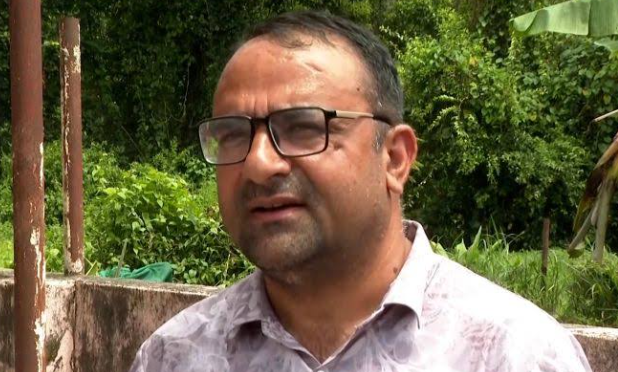
A warning from his accountant prompted Nepalese school principal Rajendra Dawadi to take swift action as devastating floods approached his school on August 26.
“My accountant came to the school and said, ‘The flood is coming, the flood is coming’,” Dawadi told AFP in a recent interview.
Dawadi immediately ordered an evacuation, with teachers rushing hundreds of students out of classrooms and towards higher ground. Within minutes, the 47-year-old watched Trishuli Bazaar Secondary School, which he had led for years, collapse into the raging floodwaters.
Dawadi said the decision involved a difficult choice: if the warning proved false, the students would lose a day of classes, but if it was accurate, their lives would be at risk. The students were frightened, with one girl fainting during the evacuation.
Bus drivers bringing additional students to the school were also instructed to turn around, including one who had just entered the school premises.
The timely evacuation ultimately saved around 900 lives.
More than a week after the disaster, Dawadi stood above the devastated riverbanks in Nuwakot district and described himself as “a principal without a school”.
A tsunami-like surge of water, ice and debris triggered by a massive glacial and rock collapse along the Nepal-China border killed at least 1,362 people and left more than 5,500 missing across the two countries.
Dawadi said five students, a teacher and a security staff member were killed in the flooding outside the school. The staff member, who left the school after Dawadi, may have stayed behind to close the school gate, he said.
Dawadi said authorities in Trishuli Bazaar had not provided residents with an evacuation plan. As floodwaters rose, some people attempting to cross a bridge were swept away, while others sought safety on higher ground.
“When I looked back, the school was standing there like the finest of buildings, and in five minutes, everything collapsed,” Dawadi recalled.
The school also held personal significance for him, as he had studied there himself. “There was nothing left,” he said.
Seventeen-year-old student Santoshi Dotel was attending an accounting class when the evacuation order was issued. She initially struggled to understand the scale of the danger and later went towards the river with a friend in an attempt to cross the bridge and reach her family home.
The situation changed rapidly as floodwaters surged and swept away the bridge.
Santoshi said she began crying after realising she might not be able to return home. Her friend helped her reach higher ground as the floodwaters roared below.
She was then left for hours uncertain about the fate of her parents. Four days later, a helicopter reunited her with her family.
“I found my mother as I stepped out of the helicopter,” Santoshi said, recalling how her mother hugged her and began to cry.
Her mother, Durga Dotel, said she had feared her daughter had not survived after seeing the river swollen by floodwaters.
According to figures cited by Save the Children, at least 69 schools were destroyed or damaged in the disaster, disrupting the education of nearly 19,000 children.
Dawadi said the devastation was “far worse” than the 2015 earthquake that struck Nepal.
The school had also been destroyed in the earthquake but was later rebuilt. This time, however, both the building and the land on which it stood have been lost.
“We need a school again. But first, we need somewhere safe to build it,” Dawadi said.